
Water is one of the most critical inputs for industry and commercial operations, but it is often the most overlooked. Every facility, whether it is a manufacturing unit, an infrastructure project, a hotel, a hospital or an institution, needs a steady supply of water that meets certain quality standards. This is why a well-designed water treatment system is so vital — not only for regulatory compliance but for the day-to-day reliability of industrial processes.
Companies seeking reliable Water Treatment Plants in Kolkata are increasingly discovering that water treatment is not a one-time installation but an ongoing operational activity that directly influences product quality, equipment life and process consistency.
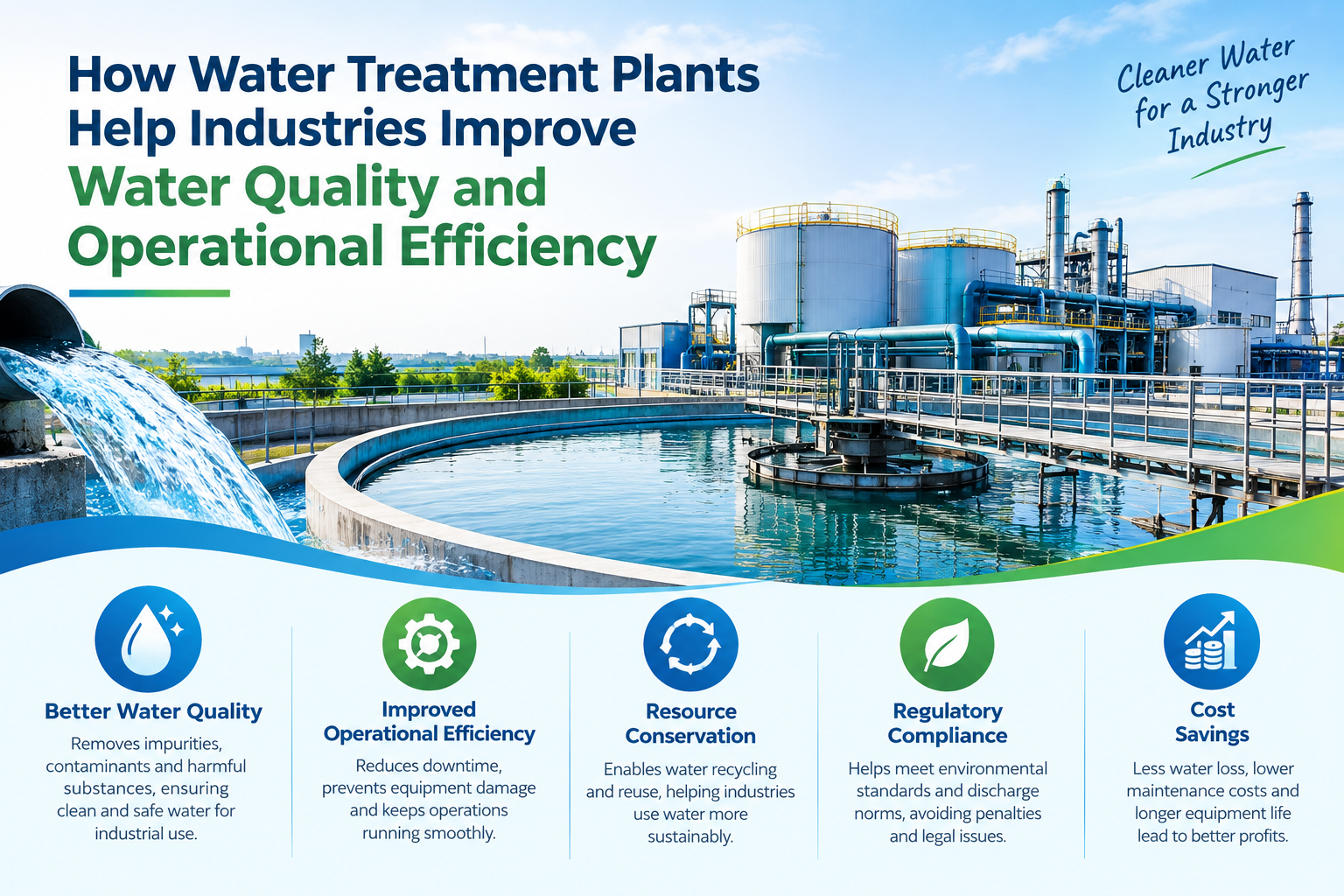
What Is a Water Treatment Plant and Why Do Industries Need One?
A water treatment plant is a system designed to remove impurities, contaminants, and unwanted chemical or biological elements from water so that it is suitable for a specific industrial, commercial or institutional use. Raw water, be it from municipal sources, borewells, rivers or recycled streams, is seldom pure enough or chemically balanced for sensitive industrial applications.
Industries need systematic water treatment due to the following reasons:
- Raw water often contains organic matter, dissolved salts, suspended solids and microorganisms
- Process water needs vary greatly by industry (boiler feed, cooling towers, product formulation, cleaning)
- Environmental regulations typically require treatment of wastewater before discharge or reuse.
- Inconsistent water quality can lead to machinery damage, decreased product consistency and more downtime
If not treated in a structured manner, industries risk scaling in boilers, corrosion in pipelines, fouling in heat exchangers and quality deviations in production batches.
Why is Processing Raw, Process and Wastewater Important
Different stages of water use in an industrial plant require different treatment approaches.
Treatment of raw water
Raw water treatment usually includes removing suspended particles, turbidity, hardness and microbial contamination before the water enters the main process line. This protects downstream equipment and provides a stable starting point for further treatment.
Water Treatment Process
Process water often needs to meet very specific chemical parameters – low conductivity for boiler feed, controlled pH for pharmaceutical or food processing, or specific limits for hardness in textile dyeing. An industrial water treatment plant is tailored to these application-specific needs.
Treatment of Wastewater
Wastewater from manufacturing, washing or process discharges is usually contaminated with materials that may not be discharged directly to water bodies or municipal systems. The water can then be treated and safely discharged, or increasingly reused within the facility – reducing overall freshwater dependency.
How Industrial Water Treatment Facilities Improve Water Quality and Operations
A well-engineered industrial water treatment plant benefits operations in many practical
ways
- Minimizes scaling, corrosion and fouling in pipes, boilers and cooling systems to reduce equipment wear
- Improves process consistency by delivering water with uniform chemical and physical properties
- Enables regulatory compliance for discharge and reuse standards
- Enables water recycling, which can reduce dependence on external water sources
- Protects product quality in industries such as food processing, pharmaceuticals, and textiles where water is in direct contact with the product
For example, a beverage manufacturing unit may require tightly controlled mineral content in water while a hospital may need microbial removal for sterile applications. Different treatment setups are required for each use case.
Commercial and Industrial Water Treatment Systems
A single treatment technology cannot be used for every application. Facilities usually depend on a combination of the following:
- Filtration Systems
Multi-media and sand filters are used in the primary treatment step to remove suspended solids and turbidity.
- Softening Systems.
Water softeners based on ion-exchange remove hardness and thus protect boilers and heat exchangers from scaling.
- Reverse Osmosis (RO) Systems
RO systems remove dissolved salts and contaminants resulting in high purity water for sensitive industrial and process applications.
- Ultrafiltration (UF) Systems
UF systems are used to remove bacteria, suspended particles and colloidal matter, often as a pre-treatment stage.
- Deionization (DI) Systems
DI systems are used in areas where almost complete removal of ionic impurities is necessary, for example, in the electronics industry or in laboratories.
- Effluent Treatment Plants (ETPs) and Sewage Treatment Plants (STPs)
These systems treat industrial or domestic wastewater before discharge or reuse to help facilities meet environmental compliance requirements.
A commercial water treatment plant for a hotel or an institutional building will have a
combination of filtration, softening and disinfection. A manufacturing unit may need a more elaborate industrial water purification plant with RO, UF and DI stages together.
Key Things to Note When Selecting a Water Treatment Plant
There is no “one size fits all” configuration for water treatment systems, and selecting the right one depends on a number of technical and operational considerations.
Capacity for Treatment
The system should be sized based on the daily water demand, peak flow requirements, and future expansion plans.
Source Water Quality
The choice of necessary treatment stages depends on the characteristics of the raw water such as hardness, turbidity, microbial load and total dissolved solids.
Water Chemical Composition
Parameters like pH, alkalinity, and mineral composition affect equipment selection and long-term performance of the system.
End Use Requirements
Water used for boiler feed, product formulation, cooling towers, or sanitation all have different quality standards that the system should be designed to meet.
Why Customized Water Treatment Plants Are Important
No two manufacturing facilities share the same water profile or operational requirements. A customized water treatment plant allows businesses to treat their specific combination of raw water quality, production needs, space constraints and regulatory requirements.
Customization may include
- Changing of treatment stages with seasonal raw water variation
- Development of modular systems for space-limited installation rooms
- Capacity planning for phased plant expansion
- Development of recycling loops for water-scarce areas
This is where working with an experienced water treatment plant manufacturer comes into its own as standard packages often cannot cater for variability seen across industrial sites.
Water Treatment Equipment: How It Works Together As An Integrated System
The individual components like filters, softeners, RO membranes, dosing systems and disinfection units do not function in isolation. They are designed to work sequentially, with each stage prepping the water for the next.
A typical treatment train, for example, might start with multimedia filtration, then softening, followed by RO for demineralization, and end with UV or chemical disinfection. If any one component is undersized or poorly matched it can affect the performance of the entire system. That is why it often results in more stable system integration to source water treatment equipment from a coordinated supplier rather than assembling disconnected parts.
Operating Costs, Maintenance, and System Life Expectancy
In addition to the initial installation, businesses need to think about the long-term operational
aspects of a treatment system:
- Energy consumption, especially for RO and UF systems, which impacts ongoing utility costs
- Maintenance requirements, including membrane cleaning, filter replacement and chemical dosing
- Spare parts availability impacting downtime for repairs
- System life span based on build quality and material selection
A system that appears to be a bargain at first can be expensive in the long run if the maintenance and energy requirements are not carefully assessed.
Automation & Monitoring Role
Today we see more and more automation of water treatment systems to give uniform, easy-to-operate systems. Features such as automated backwashing, real-time water quality monitoring and remote system alerts help facility teams respond quickly to deviations. Automation also reduces the need for manual oversight of everyday operations, which can be especially helpful in facilities that run multiple shifts.
Problems Businesses Commonly Face
Industrial facilities often have issues such as:
- Lack of consideration of seasonal variation in raw water quality
- Selecting undersized systems that cannot meet peak demand
- Inadequate pre-treatment leads to premature fouling of membranes
- Operator training not being provided, resulting in variable system performance
- Unclear service support causing delays in maintenance
These challenges are generally addressed at the design and supplier selection stage, long before installation begins.
How to Select a Water Treatment Plant Manufacturer or Supplier
Businesses should assess potential suppliers on the following before committing to a system:
- Experience in similar industrial applications
- Ability to offer custom designs instead of fixed packages
- Installation and commissioning support availability
- Availability of spare parts and consumables
- After-sales service and maintenance response times
A solution like this is an instance of how manufacturers address the design of
application-specific systems, with companies such as UNILAX WATER working with industrial and commercial clients to design water treatment systems that fit specific raw water conditions and process requirements.
The Importance of Installation, Commissioning and After-Sales Support
Even the best designed systems can perform poorly if not properly installed and commissioned. Proper commissioning guaranties that the flow rates, chemical dosing, and automation settings are calibrated to the actual conditions on the site. The continuing after-sales support – preventive maintenance and troubleshooting – is another major contributor to ensuring consistent system performance over the years.
Finding the Right Treatment Solution for Your Facility
In the end, the best water treatment solution will depend on a facility’s unique water source, intended use, capacity needs, and budget for both installation and operation. If you are a business looking for Water Treatment Plants in Kolkata, the best way to evaluate options is to first understand your raw water and end-use requirements, then work with a supplier who can translate those requirements into a practical system design.
Organizations such as UNILAX WATER give a good indication of how a typical customized industrial water treatment solution looks like, starting with the water analysis, through system design, installation and support.
Conclusion
Water treatment is no longer an afterthought for industrial and commercial facilities — it’s a functional necessity that affects equipment reliability, process consistency and regulatory compliance. Grasping the characteristics of raw water, defining the specific end-use requirements, and choosing a properly customized system can help businesses build a more stable operational foundation. Comprehensive assessment of equipment manufacturers, continuous maintenance planning and considerations for automation and monitoring all lead to a treatment system that continues to operate reliably over time.
Frequently Asked Questions
Q1. What is the difference between a water treatment plant and a water purification plant?
Purification typically refers to specific stages (like RO or UF) within the overall system, while a water treatment plant is generally used to describe a larger, process-oriented system for industrial or commercial water requirements.
Q2. How do I know what size water treatment plant my facility requires?
Capacity is generally based on daily water use, peak demand periods, and projected future growth, which would be addressed in a site-specific water audit.
Q3. Is it possible to use one treatment system to treat both the process water and the wastewater?
Usually not directly – process water treatment and wastewater / effluent treatment are usually separate systems, though could be integrated into a single water management plan for the whole facility.
Q4. Why is source water quality so important to system design?
The composition of raw water (hardness, turbidity and dissolved solids) influences the required treatment steps and sizing of equipment.
Q5. Which industries commonly require custom water treatment plants?
The manufacturing, pharmaceuticals, food and beverage, textiles, hospitals, hotels and infrastructure projects are often bespoke due to the process and compliance requirements.”
Q6. How much importance do automation have in industrial water treatment systems?
Automation helps ensure uniform operation, provides real-time monitoring and reduces the manual work required to operate routine treatment processes.
Q7. What should companies expect from a water treatment plant manufacturer?
Industry experience, ability to design a customized system, installation and commissioning support and after sales service are key considerations.
Q8. How frequently should industrial water treatment equipment be maintained?
The frequency of maintenance depends on the type of system and the water quality but generally includes regular replacement of filters, cleaning of membranes, calibration of dosing and monitoring equipment.