
If you have started looking for a customized water treatment plant in Kolkata, you might have noticed something frustrating already: hardly anyone gives you a straight number. Ask three vendors the same question and you will get three very different answers, often for the same stated capacity. This is not evasiveness on the part of vendors – it is because a water treatment plant is not a single standardized product like a water purifier you buy off a shelf. It’s an engineered system and it costs what it costs for your water, your process, your site.
In this article, we take you through the reasons why capacity alone can never be the basis for a true cost of a customized plant, what actually impacts the price up or down, and how to think about cost in a way that protects your business throughout the plant’s entire working life, not just on day one.
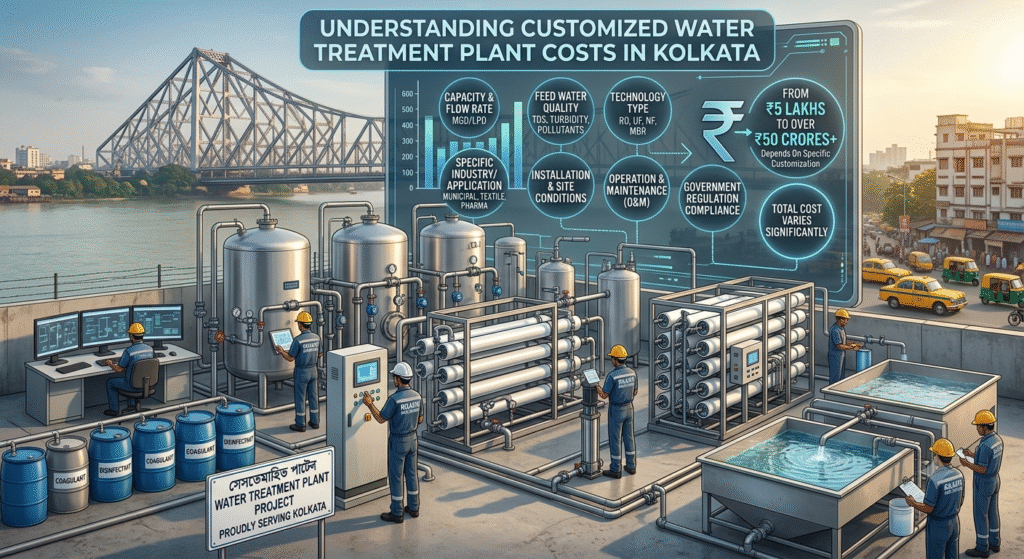
Why Capacity Alone Doesn’t Determine Cost
It is natural to think in terms of flow rates – ‘I need a 10,000 liters per hour plant’ or ‘we need to treat 50 KLD of effluent’. Capacity is certainly one input into the cost equation, but it provides a vendor with almost no information about what equipment, materials or design will be required.
Two plants of the same capacity in Kolkata can be 30–100% or more different, because capacity only tells you “how much water?” It has no reply:
- How polluted or hard is the water to begin with?
- What standard of treatment is required for the water – drinking water standards, boiler feed
- quality, process water quality, or a discharge/reuse standard?
- How many steps of treatment does it take to get there?
- Where does the water come from? Is the quality different from season to season?
- What are the civil, electrical and space constraints at the installation site?
For example, two businesses in Kolkata needing the same volume of output could require radically different treatment trains, one relatively simple and the other needing iron removal, arsenic treatment or extensive pre-treatment before even reaching the core purification stage. That is why serious water treatment providers require a raw water analysis and a clear understanding of end-use requirements before quoting anything meaningful. Capacity determines the size of the equipment; all other factors determine the actual design and price.
Major Factors That Influence the Cost of a Customized Water Treatment Plant
1. Raw Water Quality
This is typically the single biggest cost driver. Kolkata and the wider West Bengal region source water from a variety of sources – municipal (largely Hooghly-river based) supply, groundwater/borewells and in some industrial cases, surface water bodies. High levels of iron, manganese, hardness, turbidity or in some pockets arsenic and fluoride are known to be present in ground water in several parts of the region. Water that has a high total dissolved solids (TDS) content, high organic load, high turbidity or biological contamination needs additional pretreatment stages — sediment filtration, iron removal, activated carbon, chemical dosing or clarification — before it can even enter a primary treatment stage such as RO or softening. Raw water of lower quality almost always requires more equipment, more chemicals and a higher price.
- Required Treatment Process
The treatment technology needed – multimedia filtration, softening, ultrafiltration (UF), reverse osmosis (RO), demineralization (DM), or a combination of these – depends on the intended use of the treated water. Plants producing water for general washing or utility use require far less than those producing high purity boiler feed water or pharmaceutical grade process water. Not just volume but purity target. The complexity and cost scale directly with purity.
3. Plant Capacity
Of course, capacity still counts: more throughput generally means bigger vessels, pumps, membranes and piping. That adds cost. But as explained above, it is a multiplier on the design, not the design itself. The same capacity can have very different cost bases depending on all the other items on this list.
4. Source of Water
The pretreatment burden can vary significantly with the feed, including municipal supply, borewell/groundwater, river or pond water, or recycled/reused water. Surface waters generally need more extensive clarification and disinfection because of their variable turbidity and biological load; groundwater needs to be treated for whatever minerals or contaminants are locally present.
5. Treatment Stage Figures
A single stage filtration system is much cheaper than a multi-stage train of pretreatment, primary treatment, polishing and disinfection. Each stage adds its own vessels, media, membranes, controls, piping and footprint – all of which add cost but also add reliability and consistency of output when the raw water is difficult or the end use quality demands are strict.
6. Selection of Equipment
Within any treatment stage there is a wide range of equipment quality and brand available – pumps, membranes, valves, instrumentation and vessel materials (mild steel vs FRP vs stainless steel for instance) all come at different price points. Higher grade components will generally cost more money up front, but will generally last longer, break down less often and perform more consistently – an important trade-off to weigh rather than dismiss.
7. Automatization Level
Plants range from fully manual operation to semi-automated to fully automated with PLC based controls, remote monitoring and automatic backwash/ flushing cycles. Automation does increase the initial cost of the project but reduces the dependence on manpower, reduces human error and often improves the consistency of the treated water quality over time – a factor that matters a great deal for industries with strict compliance needs.
8. Civil Works
The civil work required (foundations, plant room construction, tank platforms, sumps, structural support for equipment) is very dependent on the existing site condition. A greenfield site, with no civil infrastructure in place, will require significantly more civil investment than an existing facility being retrofitted with a treatment plant.
9. Installation Requirements
Factors influencing installation complexity include where a plant will physically sit in a building (roof, basement, ground floor or a dedicated utility building) and how easily equipment can be brought into the site. Difficult access, tight spaces or multi-floor installations can mean significantly higher labor and logistics costs.
10. Available Space
Space constraints are common in many parts of urban and industrial Kolkata. This may require a more compact (and sometimes more expensive, per unit of capacity) plant design, using vertically stacked or skid mounted configurations, rather than a more spread out, lower cost layout.
11. Piping
The amount and type of piping – from the raw water intake to the plant, between treatment stages and from the plant to storage or point of use – quickly adds up on larger sites or where the plant is located away from the point where the water is actually needed.
12. Electrical Requirements
Adequate electrical infrastructure is required for pumps, dosing systems, automation panels and instrumentation. This will impact the overall project cost for sites requiring new electrical hookups, panel upgrades or backup power provisions.
13. Wastewater/Reject Treatment
Most treatment processes, especially RO, produce a reject or concentrate stream that must be disposed of, whether by simple drainage, reuse in a secondary application, or treatment through an effluent system before discharge. From a compliance perspective, this stream is not an option and the design of this stream is within the overall project scope.
14. Maintenance Provisions for Ongoing
Technically speaking, maintenance is an operating cost, not a capital cost, but the design of the plant — accessibility of components, ease of media/membrane replacement, availability of spares — directly affects how much it costs to maintain the plant over time. Some of this is decided at the design stage which is why it belongs in the cost conversation from the get-go
Initial Project Cost vs. Recurring Operating and Maintenance Cost
The biggest differentiator any business planning to evaluate a tailor-made water treatment plant in Kolkata has to make is between:
- Initial Project Cost – Initial Capital Expenditure required for equipment, civil works, installation, piping, electricals and commissioning.
- Operating and maintenance (O&M) cost – the costs incurring during the life of the plant in operation, including power consumption, chemical dosing, membrane and media replacement, spare parts, manpower and periodic servicing.
- The pair of numbers often move in opposite directions. A plant that has been designed with lower cost components and low automation may look attractive on the first quotation, but may have much higher O&M costs – more breakdowns, higher energy use, shorter membrane life, or more manual labor needed to keep it running well. In contrast, a plant that invests more at the beginning in higher quality equipment, proper automation and a well thought-out process design can end up costing considerably less over a 5-10 year horizon simply because it runs more efficiently and requires less intervention.
That’s why the number that really counts for a business decision is the total cost of ownership, not just the initial quote.
Why Businesses Should Not Just Choose the Cheapest Quote
It’s easy to think of water treatment plant procurement as a simple price comparison – get three quotes, pick the lowest. But since each plant is designed for a particular set of conditions, quotations that seem similar on paper are often not comparable in scope at all. One vendor’s quote may not include civil work, another may quote lower-grade membranes, and a third may under-size pretreatment for the real raw water quality — all of which will be seen as problems (and extra costs) after installation, not before.
A more reliable way is to compare proposals on:
- Suitability — does the design really fit your raw water characteristics and your required output quality or is it a generic package being applied to your problem?
- Lifecycle cost – what will this system really cost to run, maintain and ultimately refurbish over the life of the system, not just install?
- Treatment performance Will the plant deliver the water quality you need, consistently, as raw water quality varies during the seasons or as the plant ages?
A plant that costs significantly less upfront, but can’t reliably meet your water quality requirement, or is constantly being repaired, is the more expensive option when you factor in the downtime, the compliance risk and the hidden cost of manpower spent firefighting problems that a properly engineered system would not have had in the first place.
This is the way a company such as Unilax scopes a project – working from a detailed raw water analysis and end use requirement, not backward from a target price. It takes longer to get to a number but it’s the only way that number really means anything for your particular site and your particular water.
How to get the right price for your project
The only reliable way to know what a customized water treatment plant will cost for your business in Kolkata is to have your water tested, your requirements clearly defined and your site assessed by a qualified provider, as so much depends on site-specific factors. Beware of generic capacity-based estimates you see online or hear quoted casually over the phone; they’re rough starting points at best, not final numbers.
If you are looking at a custom water treatment plant in Kolkata, it is the provider that takes the time to understand your raw water, your process requirements and your site conditions – as Unilax does for its industrial, commercial and institutional clients – that will actually deliver a plant that performs reliably and is cost effective over its entire working life, not just on the first invoice.
Conclusion
The best way to approach an investment in a water treatment plant is to look beyond the initial invoice. Ask about life-cycle costs, treatment performance guaranties and long-term support before you settle on a vendor. A plant that is properly engineered for the specific water and site conditions will almost always outperform a generic, lowest cost alternative over the life of the plant.
If you are contemplating a Customized Water Treatment Plant in Kolkata for your business or facility, it is worth having a proper water quality assessment and site evaluation before comparing quotations. The Unilax team can help you understand exactly what your water needs are, what a realistic project cost looks like, and how to plan for both installation and long-term operation – so your decision is based on facts, not just a number on a page.
Frequently Asked Questions
Q1. How much does a customized water treatment plant cost in Kolkata?
The cost depends on water quality, capacity, treatment technology, equipment, automation, and site requirements.
Q2. Why doesn't capacity alone determine the cost?
Capacity only determines the required size, while water quality and treatment requirements determine the actual system design and cost.
Q3. What factors affect the cost of a water treatment plant?
Raw water quality, treatment process, capacity, equipment, automation, civil work, installation, piping, electricals, and reject treatment all affect the cost.
Q4. Does raw water quality affect the plant cost?
Yes, poor-quality water may require additional pretreatment and therefore increase the overall cost.
Q5. Does the required treated-water quality affect the cost?
Yes, higher purity requirements generally require more advanced and expensive treatment processes.
Q6. Does automation increase the cost?
Yes, but automation can reduce manpower needs, human error, and operating issues over the long term.
Q7. Does the installation site affect the cost?
Yes, difficult access, limited space, rooftops, basements, and multi-floor installations can increase installation costs.