
Water is a raw material, a cleaning agent, a coolant and an ingredient. And where quality is inconsistent, effects include scaling in boilers, fouled heat exchangers, off-spec products, failed audits and increased maintenance costs; An effectively designed Water Purification Plant helps organizations manage these risks by offering water treatment to a desired level appropriate for its intended use.
This article explains the working principle of reverse osmosis (RO) and similar technologies, the interaction between the individual treatment stages and what decision makers should consider when investing in a system.
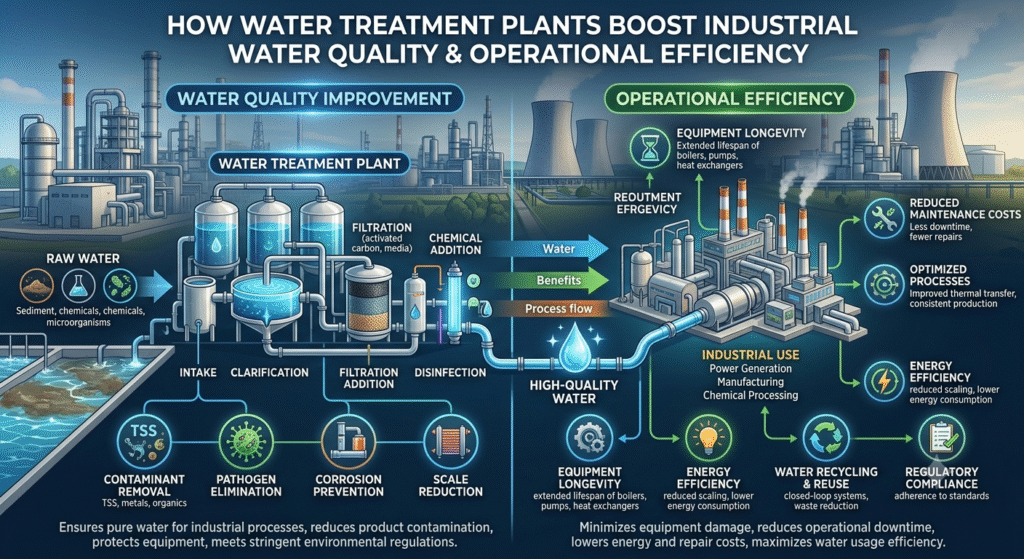
What is water treatment plant?
A water purification plant is a system that is designed to combine several processes to reduce contaminants in raw water. Depending on the design it can remove suspended solids, dissolved salts, hardness, organic matter, chlorine, micro-organisms and other impurities.
How it works and how it is different from simple water filtration
- Since particles are the main thing a water filtration plant pulls out. Sand filters,
- cartridge filters and the like trap sediment and turbidity. That is helpful but filtration alone will not remove dissolved salts, dissolved minerals or many chemical contaminants.
A purification plant goes a step further, mixing physical, chemical and membrane-based processes. In practice , filtration is often one stage inside a larger purification system rather than a separate alternative .
Why Water Quality Standards Vary
Very different water is needed by different users
- Residential: Water is typically treated for taste, odor and rudimentary safety.
- Commercial (Hotels, Hospitals, Institutions) : The demands are more stringent. Boilers, laundry equipment, hotels, they worry about scaling. In hospitals, reliable quality is needed in sterilization areas and clinical support.
- Industrial: Requirements are typically process-defined. Each of these applications, boiler feed water, cooling towers, food & beverage production and pharmaceutical manufacturing, has limits on hardness, conductivity, silica, microbial load and other parameters.
Therefore, no one design is suitable for all sites, and the treatment train needs to be matched to the application.
How Reverse Osmosis Works
Reverse osmosis uses pressure and a semi permeable membrane. The feed water is pumped to a pressure higher than its osmotic pressure. Water molecules are forced through the membrane, rejecting most of the dissolved salts, organics and other impurities.
The system produces two streams:
Permeate: the water with low dissolved solids.
Reject stream: the stream that carries the rejected contaminants out of the system.
What Makes RO So Popular
RO is popular in industrial applications for a number of reasons:
- It cuts down a wide variety of dissolved pollutants at the same time.
- It operates 24/7 and can be scaled up or down in capacity.
- It generally uses fewer chemicals than older demineralization techniques such as ion exchange.
- It can be a first step before polishing steps such as deionization for higher-purity needs.
Thus RO water treatment plant has become integral to many industrial and commercial setups.
Pre-Treatment Role Before a RO Plant
RO membranes are fragile. Suspended solids, iron, chlorine, hardness and organic matter can foul, scale or chemically damage them. Pre-treatment is important to protect the membranes and achieve stable performance.
Pretreatment is typically done in the following steps:
- Multimedia or sand filtration to reduce suspended solids and turbidity.
- Filtration on activated carbon to eliminate chlorine and organic compounds that can damage the membranes.
- Hardness and scale mitigation via softening or anti-scalant dosing.
- Removal of iron and manganese if they are present in ground water.
- Cartridge filtration last line of defense before high pressure pump.
Skipping or under-sizing pre-treatment is one of the most common reasons that RO systems underperform.
How Filtration Removes Unwanted Contaminants
Industrial water filtration addresses the physical side of water quality. Depending on media and rating filters can eliminate:
- Sand, silt and sediment
- Suspended Solids & Turbidity
- Iron & Rust Particles
- Some organic compounds (by activated carbon) and chlorine
- Micron-rated cartridge or filter (fine particles)
Take a plant that is drawing water from a high sediment borewell. Multimedia filtration is often the first line of defense. It protects the downstream equipment and reduces the load on the RO stage.
Typical stages of an industrial water purification system are:
Designs vary but a typical industrial water purification system might include:
- Raw water storage and equalization — Permits stabilization of flow and feed conditions.
- Coagulation or chemical dosing (if required) assists in the removal of fine suspended matter.
- Multi media filtration: Removes suspended solids and turbidity.
- Activated carbon filtration: Removal of organics, chlorine.
- Softening or antiscalant dosing: manages hardness & scale risk.
- Cartridge filtration protects the membranes and the pump.
- Reverse Osmosis – for removing dissolved salts and other impurities.
- Post-treatment: pH adjustment, deionization, UV disinfection, or other polishing steps as required by the application
- Storage and distribution of treated water: supplies water to the point of use.
Not every plant needs them all. Design should be based on water analysis and end-use.
RO Plant & Filtration Plant or both?
Companies often ask what tech they really need. Here are some questions to guide us:
- What is the issue: turbidity, sediment or visible particles?
A filtration plant might do the trick. - Is the problem dissolved salts, high TDS, hardness or conductivity? Probably a RO plant with appropriate pre-treatment would be required.
- Are there any dissolved particles or contaminants? Usually the practical answer is a combination. First filtration then RO.
- Does the process require very high purity? RO can be followed by polishing technologies
For example a hotel with hard borewater may need softening and filtration for laundry and boilers whereas a pharmaceutical unit needs multi-stage pre-treatment, RO and further polishing. The same name of a technology can be used for very different designs of systems.
How to Choose a RO Water Treatment Plant
Start with Water Testing and Analysis
To design on the assumption that … is a dangerous thing to do. A water analysis should be done before selecting equipment. Parameters that are often looked at are:
- Conductivity & TDS
- Alkalinity and pH Hardness
- Turbidity and suspended solids
- Iron, manganese, silica
- Chlorides and other anions, sulfates
- Microbiological markers
- Seasonal variability as surface and ground water quality can vary during the year
Testing is also critical for regulatory and quality assurance purposes, especially in food, beverage and pharmaceutical operations.
Applications, Recovery, Capacity & Feed-Water Quality
Most RO designs are driven by four factors:
- Feed-water quality: affects pre-treatment requirements, membrane type and expected fouling behavior.
- Capacity : should be sized to peak and average demand, storage availability and future growth, without significant oversizing.
- Recovery : Ratio of permeate to feed water. More recovery means less reject, but it does increase the risk of scaling and fouling. This must be balanced against the feed water chemistry.
- Application to be used on : boiler feed , process water , cleaning , cooling or drinking water each has different quality objectives .
- Pumps, Filters, Membranes & Other Equipment
Water treatment equipment is designed to work as a system where each component impacts the others:
- Membranes: Selection must be based on feed-water salinity, temperature and fouling potential.
- Filters and media: Need to match the particle load and flow rates.
- High pressure pumps – sizing for the required pressure and flow, considering efficiency and materials.
- Controls, pressure gages, flow meters, and conductivity meters are used in monitoring and operation.
Construction materials shall be compatible with water chemistry and sanitary requirements.
Common Operation and Maintenance Problems
Even the best designed RO and filtration systems have periodic problems:
- Membrane fouling: Particulate, organic or biological deposits result in reduced production.
- Scaling: Hardness salts precipitate on membranes as a consequence of bad recovery or dosing.
- Chemical Damage Residual chlorine or improper cleaning can damage membranes.
- Media and cartridges lose effectiveness as they become clogged.
- Pump wear, pressure variations: impact on flow and energy usage
- Feed-water variations Changes in the feed-water source or seasonal variations can change the conditions for which the system was designed.
Monitoring and Maintenance Support Reliability Performance
Looking ahead helps you spot problems sooner.
- Monitor pressures, flow rates and permeate conductivity.
- Get in the habit of recording operating data so trends are visible.
- Set up cartridge replacements, filter changes, flushes.
- Clean membranes based on performance data, not guesswork.
- Test feed and treated water at intervals.
- Train personnel in alarm response and procedures.
Routine monitoring generally leads to longer equipment life and less unplanned downtime.
Selection of RO Plant Manufacturers and Equipment Suppliers
In the long term result technology is not the only factor, the manufacturer or supplier has a say in this too. Useful points of assessment are:
- Design approach: do they need to have water analyzes and application details before proposing a system?
- Experience: do they have similar industry and capacity experience?
- Component visibility. Are the membrane, pump and filter specifications clearly stated?
- Documentation Are drawings, operating manuals and commissioning procedures supplied?
- Post-sales support: availability of spares, service and operator training.
- Scope is clear. What is covered? What performance data is given? At what feed water conditions?
Companies like Unilax design and supply a Water Purification Plant, RO water treatment systems, filtration systems and industrial water treatment equipments. When comparing any supplier it is wise to ask for references, review technical proposals side by side and confirm what assumptions a proposal is based on.
Why is customization key
Standard packaged units can be quite effective for simple requirements. But industrial sites often have specific constraints, such as unusual feed-water chemistry, limited space, fluctuating demand or very tight product-quality targets. A custom industrial RO plant or commercial RO plant can be configured with custom pre-treatment, membrane selection, capacity staging and automation to suit these conditions. Customization allows for future expansion, so you don’t have to spend money on redesigns as demand increases.
Conclusion
A well designed Water Purification Plant improves water quality by combining the right technologies in the right sequence: pre-treatment to protect the system, filtration to remove particles and reverse osmosis to reduce dissolved contaminants. Design must be based on sound water analysis and clear definition of intended use. Then capacity, recovery, membranes, pumps and instrumentation can be reasonably defined.
Long term performance is as much about monitoring and maintenance and working with suppliers who are clear about design assumptions and provide ongoing support. Purification as a designed-for-purpose system empowers organizations to provide reliable operation and consistent water quality.
Frequently Asked Questions
Q1. Difference between water filter plant and water treatment plant?
The removal of suspended solids, sediment and turbidity is primarily achieved in water filtration plants by means of media or cartridge filters. Water purification plant employs various processes including often filtration, RO and disinfection to deal with dissolved contaminants and other impurities also.
Q2. Do I need pre-treatment for RO water treatment plant?
Most of the time, yes, industrial and commercial. Pre-treatment such as multimedia filtration, carbon filtration and scale control prevents fouling, scaling and chemical attack on membranes. The precise steps will be determined by the feed water analysis.
Q3. What to look for when selecting RO plant manufacturers?
Look for suppliers that start with water testing, state their design assumptions, list the key components, and provide documentation, spares and service support. Comparing proposals to your own water data and application requirements is more reliable than just comparing capacity or price.