
Demand for safe packaged drinking water is rising in homes, offices, hotels, hospitals and events. This makes packaged drinking water plant an attractive project for entrepreneurs and manufacturers. But a successful plant is the result of careful planning from water source evaluation to equipment selection to regulatory checks. This guide sets out the practical steps.
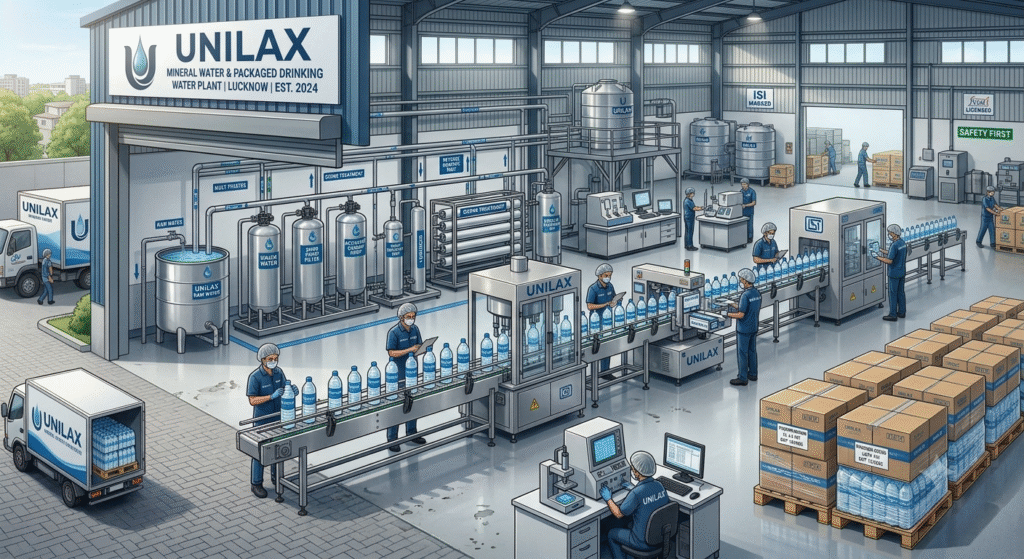
What is Packaged Drinking Water Plant?
A packaged drinking water plant uses raw water from borewell, municipal supply or other sources. It treats the water to get rid of impurities and microorganisms, and fills, seals, labels and packs it for distribution. A mineral water processing plant can also add controlled mineral content to improve taste and consistency.
Depending on the market it serves, the facility can produce bottles, jars, pouches or cups.
The Basic Production Steps
The sequence of operations followed by most bottled water plants is similar:
- Raw water procurement and storage
- Pre-treatment and filtering of
- purification, often by reverse osmosis (RO)
- If desirable, addition of minerals Disinfection
- Treated water storage
- Washing, Filling & Capping Bottles
- Labeling batch coding and packing
- Quality check and shipping
The effect of each stage on the next must be considered so that the plant is designed as a connected system rather than a number of separate machines.
Priority of Raw Water Testing
Have your raw water tested by a qualified laboratory before buying any equipment. Water quality varies widely from place to place, and the results shape the entire treatment design.”
A typical analysis includes:
- Total dissolved solids (TDS)
- Iron, manganese and hardness
- Turbidity and color
- Sulfates, nitrates and chlorides
- Microbiological contamination
- Any area-specific contaminants
For example a borewell with high iron needs to be oxidized and iron removed before RO. A source with moderate TDS and low turbidity may require a simpler pretreatment train. This is one of the most expensive mistakes a new plant owner can make.
RO and other purification technologies
RO mineral water plants are common due to reverse osmosis’s ability to remove dissolved salts and many other impurities. But RO does not work by itself. It requires well treated feedwater. Otherwise, its membranes will foul or scale easily.
Other technologies are often used in conjunction with RO depending on the raw water and the product:
- Ultrafiltration (UF): remove suspended particles and some microorganisms.
- Activated carbon filtration removes odor, chlorine and organic compounds.
- Softening: Controls hardness which can scale RO membranes.
- Disinfection: UV treatment or ozonation
The right blend is dictated by the product you are trying to sell and the test results.
Stages of Filtration, Disinfection, Storage and Treatment
Water processing usually includes the following steps:
- Pre-filtration: removal of suspended solids, turbidity by sand and multimedia filters.
- Adsorption: chlorine and organic matter are removed with activated carbon filters.
- Polishing: micron cartridge filters protect downstream membranes.
- Purification: Dissolved and microbial contaminants are reduced by RO or UF.
- Mineral dosing: If the product is sold as such, then controlled mineral addition is used.
- Disinfection: ozone, UV or both prior to filling.
- Storage: hygienic, food-grade tanks are used for storage of treated water.
Storage is a consideration. Poor tank design, long holding times and contaminated pipework can compromise even well treated water.
What is in the machinery of the mineral water plant
Generally mineral water plant machinery include the treatment section, and the packaging section. Typical items include
- Raw water tanks and feed pumps
- Carbon and multimedia filters
- Cartridge filters and softners
- RO and UF units
- Mineral dosing units
- Ozonators & UV Sterilizers
- Water storage tanks (treated)
- Filling, rinsing and capping machines
- Labeling, coding and shrink wrapping machines
- Routine testing laboratory instruments
UNILAX WATER is one of the companies that offer water treatment systems and mineral water plant solutions. Buyers can compare configurations and see Mineral Water Plant Machinery options from UNILAX WATER and other suppliers.
Machinery Selection by Capacity and Operations
The choice of mineral water plant equipment is not about buying the biggest system you can afford. It’s about matching machinery to your production capacity, your product mix, your labor availability and your growth plans.
A small plant selling to a local market may use semi-automatic filling and manual packing. A larger facility serving distributors may require automated rinsing, filling and capping lines. Sales are limited if the equipment is undersized and capital is tied up and it may run inefficiently at low loads if it is oversized.
How a Bottling Plant Combines Treatment and Filling
A mineral water bottling plant works best when treatment and packaging are in balance. The treatment section needs to supply the water at such a flow rate that the filling line can work continuously and the treated-water tank serves as a buffer between the two.
For example, if your filler runs at 2,000 bottles per hour, your RO output, storage volume and disinfection capacity must meet that demand, including allowance for RO reject water and cleaning cycles. They lead to idle machines, bottlenecks, or water held too long before filling.
Important Factors to Setup Mineral Water Factory
To start a mineral water factory is not just machinery. Next plan for:
- Space: different areas for raw water, treatment, filling, packaging, storage and the laboratory
- Production flow one way system to reduce cross contamination and handling
- Utilities: dependable power, backup power, water, drainage, compressed air if necessary
- Reject water management: RO generates reject water that requires a proper use or disposal plan
- Building design: floors, walls, ventilation and pest control, easy to clean.
- Raw Material Storage: Clean areas for bottles, caps, labels and cartons
Regulatory Requirements
Bottled drinking water is a regulated commodity. Before setting up a plant, the latest applicable BIS, FSSAI, environmental, local and other requirements should be checked with the concerned authorities. These rules can change and requirements can vary by state, type of product and plant size.
But buying the right equipment is no guaranty of approval. The plant owner is still responsible for licensing, laboratory tests, documentation and inspections.
Getting the Right Capacity
To estimate the packaged drinking water plant capacity, consider the following:
- Expected daily and peak demand
- Product mix (for example, 250 ml, 1 liter, 20-liter jars)
- Working days and shifts
- Distribution extent and seasonal variation
- On a budget and room to grow
Many businesses start with a moderate capacity and the layout is designed to allow for expansion of treatment and filling later. A realistic assessment is more reliable than optimistic assessments of the market.
Automation, Hygiene, Quality control and Maintenance.
Automation can reduce the need for manual handling and improve consistency, but it can also increase the initial investment. Select the level that best fits your volumes, staff skills and local service support.
Good hygiene and quality control should be part of the normal working practices:
- Training of staff in hygiene and protective clothing
- Tanks, pipelines and filling heads are sanitized regularly
- In-process controls (TDS, pH, disinfection levels)
- Regular microbiological and chemical testing
- Traceability and Batch Records
And Maintenance is just as important. Program membrane cleanings, filter media and cartridge changes, UV lamp replacements and pump maintenance. Maintain a stock of critical spares to avoid long turnarounds.
Selecting a Mineral Water Plant Manufacturer
When you are evaluating a mineral water plant manufacturer, do not just check the quote:
- Experience with the same type of plants as yours
- Designing around your water analysis, if desired
- Equipment and material quality specifications are clear
- Installation, commissioning and operator training support
- Availability of spare parts and after-sales service
- Testimonials from current customers (you can verify it yourself)
Ask for a detailed scope of supply so you know exactly what is included and what is not.
- Common Mistakes to Avoid
- Buy equipment prior to testing raw water
- Choosing capacity on price alone
- Excluding reject water, drainage and power backup.
- Underestimating storage and movement space
- Licensing as an afterthought.
- Not maintaining and training staff
- Cutting costs at the expense of hygiene
- Planning Integrated Treatment and Bottling Solution
Begin with your market and how much you want to produce. Test the water, figure out the treatment train, then choose the filling and packaging equipment that is compatible with the output of the treated water. Confirm utility needs and layout, and review regulatory steps simultaneously. Having one supplier doing the treatment and bottling will make coordination easier, but you still want to compare and make sure responsibilities are in writing.
Conclusion
The setting up of a mineral water or packaged drinking water plant is an exercise in both business and technical and regulatory issues. Raw water testing. Good design of treatment. Sizing machines correctly. Layouts that are hygienic. Maintenance discipline. The foundation. Allow some time to check on regulatory requirements, compare suppliers carefully and plan for growth. The long-term consistency of quality is better assured by a well-designed facility.
Frequently Asked Questions
What are the parts of a mineral water plant machinery?
It generally includes filtration units, RO or UF systems, mineral dosing, disinfection equipment, storage tanks and filling, capping, labeling and packing machines.
Suitable for all sources of water RO mineral water plant?
Not always. RO is applicable for many sources but pre-treatment and design are based on the water test results such as TDS, hardness, iron and turbidity.
What is the difference between a mineral water bottling plant and a water bottling plant?
The terms are overlapping. Mineral water bottling plant usually means mineral addition or mineral related positioning. Water bottling plant is a broader term.
Why do you need to test raw water?
It identifies contaminants and helps design treatment to avoid destruction of membranes or under or over specified equipment.
What is the capacity of a packaged drinking water plant?
Estimate demand, product mix, working hours, growth plans, size treatment and filling equipment to suit.
Will I get regulatory approval if I purchase the equipment?
No. You are required to check and comply with the latest BIS, FSSAI, environmental and local authorities requirement.
How much space is needed for a mineral water factory?
Depending on the capacity and automation. Provide for separation and allowance for expansion of treatment, filling, packaging, storage and laboratory areas.
How frequently should plant equipment be maintained?
Schedule according to the manufacturer. Filters, membranes, UV lamps and filling machines have different service intervals and regular inspection prevents breakdowns.