
Each manufacturing unit, processing and commercial establishment which uses water also generates waste water. Untreated, that water can carry oils, chemicals, solids, and organic matter that harm soil, groundwater, and public water bodies. It can also lead to regulatory trouble, operational disruption and damage to reputation. A well designed Effluent Water Treatment Plant offers industries a structured way to address this responsibility.
This article describes how these systems operate, how they differ from other water treatment systems, and what industries should consider when designing, purchasing, and operating one.
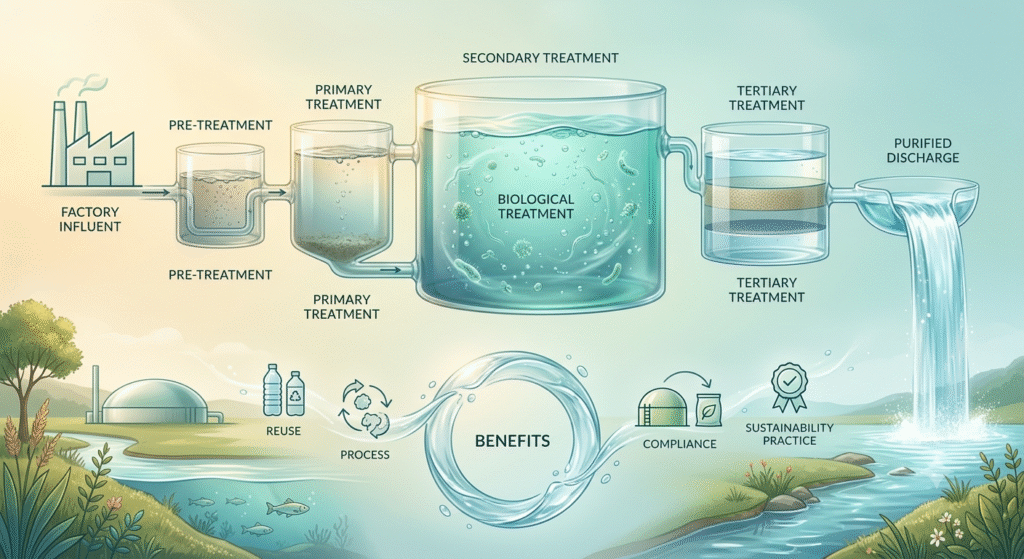
What is Effluent Water Treatment Plant?
An Effluent Water Treatment Plant is a facility for the treatment of wastewater arising from industrial or commercial activity for reuse, recycling or discharge in accordance with the applicable requirements. ETP Plant and Effluent Treatment Plant are used interchangeably in industries.
Industries require effluent treatment for several reasons:
- Environmental protection: Untreated discharges can affect water quality and ecosystems.
- Regulatory obligations Most jurisdictions impose conditions on what can be released and where.
- Water reuse: treated water can often be reused (for cooling, washing or gardening) reducing freshwater demand.
- Operational continuity: If a facility cannot deal with its wastewater, it may be subject to shutdown notices or production limits.
ETP vs Wastewater Treatment Plant vs Other Systems
The terms intersect, but there are pragmatic distinctions.
ETP (Effluent Treatment Plant): generally refers to treatment of liquid waste from industrial processes, such as textile dyeing, pharmaceutical production, or food processing.
Wastewater Treatment Plant: a more general term that can also encompass industrial, commercial and domestic wastewater. A sewage treatment plant (STP) is concerned solely with sanitary wastewater from buildings and settlements.
Water treatment systems: these usually treat raw water, borewell water, etc. to make it suitable for process or drinking purposes. Examples are filtration, softening and reverse osmosis units.
In essence, water treatment is a process to prepare water for use, and effluent and wastewater treatment is a process to treat water after use. Many facilities require both.
Why Industrial Wastewater Is Different
No two industries produce the same effluent, and even two plants in the same industry may differ. Some examples:
- Food and beverage units are often characterized by wastewaters with high organic load, fats, oils and grease.
- Textile and dyeing units produce water of variable pH with dissolved chemicals, which are colored.
- Metal finishing and engineering units may discharge water containing heavy metals, acids and oils.
- Pharmaceutical and chemical plants may have complex effluent with solvents or difficult-to-degrade compounds.
- Commercial establishments, such as hotels, hospitals and malls, typically produce lower strength wastewater, but with significant variation in flow.
Wastewater characteristics depend on raw materials, production processes, cleaning routines, batch vs. continuous operation and seasonal changes. This is why a copy-paste design seldom works.
How Wastewater Testing Influences Treatment Design
Characterize your wastewater prior to any equipment selection. Sampling and laboratory analysis typically will look at:
- pH and temperature
- Total Suspended Solids (TSS) and Total Dissolved Solids
- Biochemical oxygen demand (BOD) and chemical oxygen demand (COD)
- Oil & Grease
- Specific contaminants like metals, ammonia, phosphates or color
Flow rates and variations matter, too. A plant that unloads heavily during a morning shift needs a different design than one with a steady flow. The analysis assists engineers in determining the necessary treatment stages, their sequence, and the required scale. One of the most common causes of underperforming systems is skipping this step.
Common Stages of Industrial Wastewater Treatment
While designs vary, most Industrial Wastewater Treatment systems follow a sequence.
Initial treatment
Screens and grit chambers take out large debris, rags and heavy particles that could damage pumps and downstream equipment. Oil and grease traps can be installed here as well.
Initial Treatment
Equalization tanks equalize flow and load so that downstream units get a consistent feed. Sedimentation or flotation is then used to remove settleable solids and floating material.
Secondaries
This stage is intended to remove dissolved and colloidal organic matter, normally by biological methods.
Tertiary/Advanced Treatment
When tighter limits or water reuse is required further steps such as filtration, activated carbon, membrane systems or disinfection may follow.
Sludge Disposal
The solids produced at each step must be properly thickened, dewatered and disposed of.
Physical, chemical and biological processes
Industrial Effluent Treatment typically combines three families of processes.
Physical processes separate the contaminants, but do not chemically change them. These are things like screening, sedimentation, flotation and filtration. They are suitable for suspended solids and floating matter.
Chemical processes use reagents to change the state of the water. Typical examples include pH neutralization, coagulation and flocculation, metal precipitation, and oxidation or disinfection.
Biological Processes The organic pollutants are degraded by the microorganisms. Organic rich wastewaters, such as from food and dairy processing, are often treated using activated sludge, moving bed biofilm reactors, or anaerobic digesters.
The appropriate combination for a facility depends on what is in its wastewater. A galvanizing unit may depend heavily on chemical precipitation, while a distillery may depend on biological treatment.
Specific Parameters Covered
A well-designed Wastewater Treatment System aims at the contaminants that are important for the effluent in question:
- Suspended solids. Screening, clarification and filtration.
- Organic load (BOD/COD): biological treatment, generally preceded by chemical pretreatment.
- pH: acid or alkali dosing under controlled conditions for neutralization.
- Oil and grease: Oil separators, skimmers, or dissolved air flotation.
- Metals and specialty contaminants: Precipitation, adsorption, ion exchange or membrane based approaches depending on the case.
Actual performance is dependent on influent quality, design, operation and maintenance, and therefore no system should be assumed to treat all contaminants equally well.
Why Capacity and Composition Are Driving Forces in ETP Design
Nearly every design decision is influenced by two inputs: how much wastewater there is and what is in it.
Undersizing leads to overloaded units, poor results and frequent breakdowns. Oversizing wastes capital and can lead to operational problems such as biological systems starved of load. Good designers consider peak flows, future expansion, and variability in pollutant concentration. Facilities also should communicate information about planned changes in production, since a new product line can have a significant impact on effluent characteristics.
What Is Included in a Turnkey Water Treatment Plant?
A Turnkey Water Treatment Plant approach places the project responsibility on a single provider, from concept to commissioning. Turnkey Water Treatment Solutions usually comprise:
- Site inspection and wastewater testing
- Process design and engineering
- Selection and supply of Wastewater Treatment Equipment, such as pumps, tanks, blowers, clarifiers, filters and dosing systems
- Civil & Structural Requirements
- Electrical, Instrumentation and Automation work
- Installation and commissioning
- Operator Training and Documentation”
This end-to-end scope is offered by companies such as Unilax, which provides industrial wastewater treatment, ETP, and turnkey water treatment solutions. For facilities looking at an Effluent Water Treatment Plant for the first time, single point of responsibility simplifies planning.
Benefits and Issues of Integration
Benefits:
Less design, supply and installation coordination gaps
Matched components
Clearer accountability and more predictable project timeline
One contact for post-commissioning support
Things to think about:
Check what’s really included in the scope, as “turnkey” definitions vary.
Identify approvers, utilities, civil work.
Ask about how the system can be extended or modified in the future.
Consider how much you will be locked into a single supplier for parts and service.
Operation and Maintenance Common Challenges
It’s not that simple for a well-built plant. Common issues are:
- Rapid changes of effluent load or composition e.g. a cleaning cycle releasing high strength waste
- Biological treatment upset by shock loads
- Blocked screens, contaminated diffusers, and worn pumps
- Errors in chemical dosing
- Operator training not sufficient
- Sludge buildup above storage or handling capacity
- Monitoring, Testing, Sludge Management and Maintenance
Regular habits make a big difference
- Monitoring and testing: The regular check of pH, solids, COD/BOD and other relevant parameters will reveal problems at an early stage and will provide records for authorities.
- Sludge management: sludge can be a substantial part of operating cost. Some sludges are classified as hazardous and it must be dewatered, stored and disposed of through authorized channels.
- Preventive maintenance: Scheduled servicing of mechanical equipment, calibration of instruments and planning of spare parts reduce the unplanned downtime.
- Operator training: Abnormal conditions are identified by trained personnel before they escalate into failures.
Selecting An ETP Plant Manufacturer
Choosing an ETP Plant Manufacturer is a long term decision. Industries should ask:
Technical experience with wastewater comparable to theirs
Willingness to undertake wastewater analysis rather than proposing a standard design
Equipment quality, transparency on specs and materials
Scope clarity, describing what is included and what is not included in the quotation
Ability to discuss reference projects
After sales support (spares, servicing, fault finding)
Operating costs (power, chemicals, labor, sludge handling, etc.) Not just purchase price
Tailored solutions for industry-specific requirements
Industrial Water Treatment Solutions work best when customized. A dairy needs solid fat and organic load control. A electroplating unit requires good control of metals and pH. A hospital or hotel may prefer compactness and odor control. Site constraints such as limited space, existing infrastructure, or goals for water recycling also can influence customization. Instead of asking what models they sell, ask potential providers how they adapt designs.
Environmental standards and discharge limits
Compliance is a core value at ETP Water Treatment but it’s not a one-size-fits-all approach. Applicable standards and permissions may vary by industry, location, discharge destination, and regulatory authority. Discharge limits to a municipal sewer, an inland surface water body or land application may be different, and some areas require zero liquid discharge for some sectors.
Regulations also evolve over time. Businesses should seek guidance from the appropriate authorities, such as the pollution control board or its equivalent, and obtain suitable professional assessments prior to finalizing a design. A properly designed, operated and tested treatment plant is a tool to work toward compliance.
Conclusion
Managing industrial wastewater is not only a regulatory requirement, it’s also smart business practice. An effective Effluent Water Treatment Plant starts with a clear understanding of your wastewater, matches the treatment stages to the characteristics of the wastewater and is sized for real capacity and future growth. Turnkey or phased, the basics are the same, analyze first, design thoughtfully, operate consistently, monitor regularly and confirm requirements with the authorities that govern your discharge.
Plants that view wastewater management as a continuous process, not a one-time installation, can better protect the environment, control costs and keep production moving forward.
Frequently Asked Question
Q1. Effluent Water Treatment Plant?
It is a facility that treats wastewater from industrial or commercial activity so that the water can be reused or discharged according to applicable requirements.
Q2. What is an ETP and how does it differ from a sewage treatment plant?
An ETP is used to treat industrial process wastewater that may contain chemicals, oils or metals. A sewage treatment plant is a treatment plant for domestic or sanitary waste water which is primarily organic.
Q3. What Industries Need an ETP Plant?
Many manufacturers need one, such as textiles, food and beverage, pharmaceuticals, chemicals, metal finishing, paper, tanneries, and many others, and some commercial establishments may also require one, depending on regulations and wastewater type.
Q4. Why waste water analysis is required before designing a plant?
Analysis identifies the contaminants, their concentrations, and the flow patterns involved. This helps to define the right treatment stages and capacity and reduce the risk of inadequate design.
Q5. What is normally included in a Turnkey Water Treatment Plant?
It usually includes design, supply of equipment, installation, commissioning and often training. The exact scope is not fixed and should be confirmed in writing.
Q6. Reuse of treated wastewater
Yes, in many cases, for applications such as cooling, cleaning or landscaping, depending on the treatment level and the quality required for the end use.
Q7. How often should an industrial wastewater treatment system be serviced?
Routine checks should be daily or weekly with scheduled preventive maintenance based on type of equipment and manufacturer guidance. Frequency is load and operating condition dependent.
Q8. What should I look for when comparing wastewater treatment equipment suppliers?
Check their experience with similar effluents, clarity of scope, quality of equipment, service after sales, operating costs and their willingness to customize the design for your facility.