
Introduction
West Bengal is one of the most active industrial and agricultural region of eastern India. Kolkata, Howrah, Hooghly, Durgapur, Asansol, Haldia and other places are dotted with textile units, jute mills, food processors, tanneries, chemical plants, pharmaceutical manufacturers and engineering works. Many of these industries consume large amounts of water and produce wastewater that must be treated properly.
Properly designed wastewater treatment plant in West Bengal helps to protect Hooghly and Damodar rivers, protect ground water and also helps industries to comply with environmental regulations. It also reduces the need for fresh water by providing treated water for re-use.
Waste water treatment is important. This article explains how each treatment stage works, and how industries can manage effluent efficiently and compliantly.
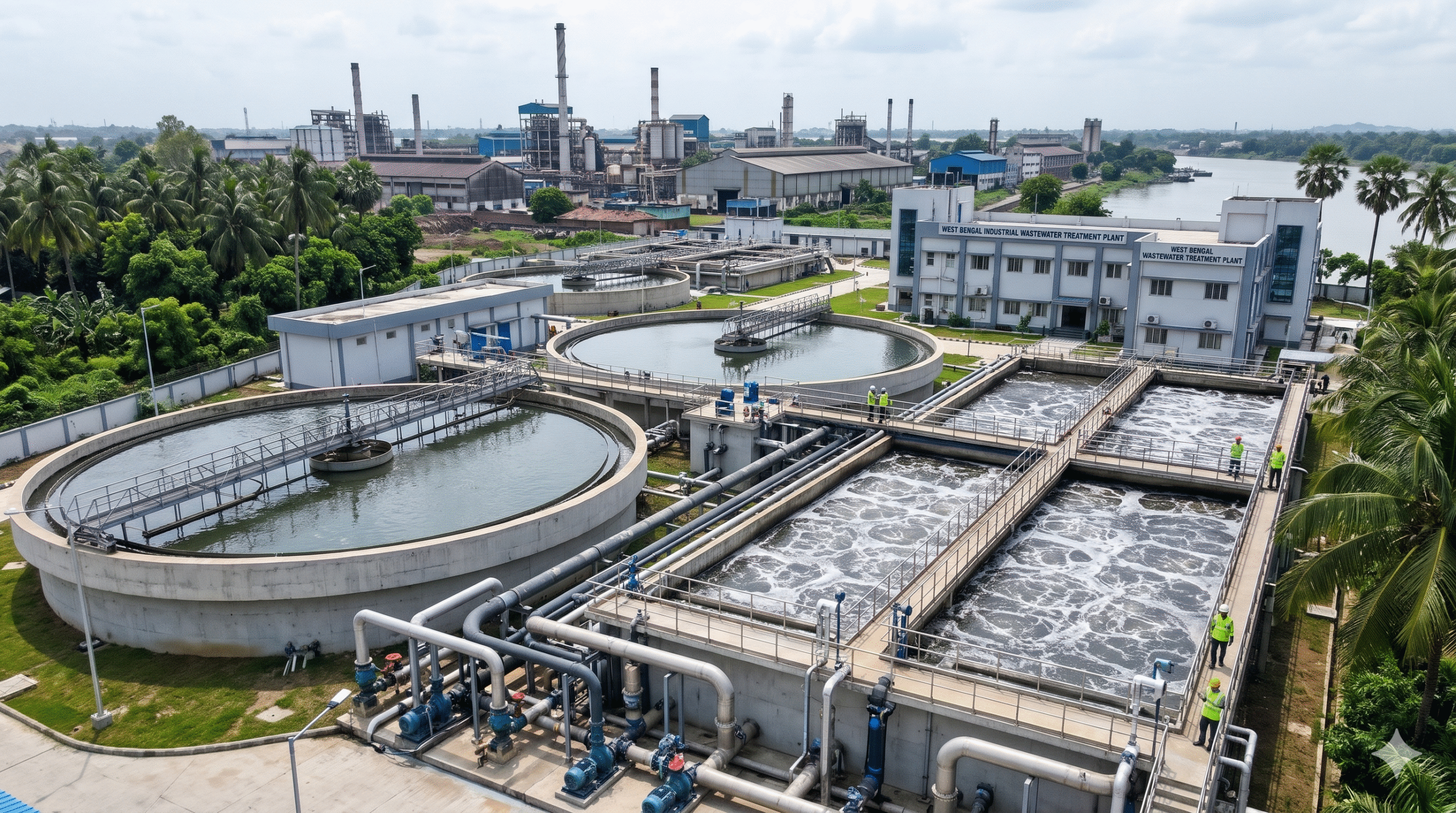
Why Wastewater Treatment Matters in West Bengal
Protecting rivers and groundwater
Untreated effluent contains organic matter, suspended solids, oils, heavy metals, dyes and chemicals. Once released into drains or rivers it degrades water quality, harms aquatic life and can contaminate drinking water sources.
Compliance with Regulations
Industries in West Bengal are required to comply with the discharge standards laid down under the Indian environmental law and enforced by the West Bengal Pollution Control Board (WBPCB) and the Central Pollution Control Board (CPCB). The standards differ depending on the type of industry, the location and the receiving body (surface water, land or sewer). Each facility should check with the authorities its specific consent conditions.
Water security and savings
Water treatment and reuse for cooling, washing, gardening or process use reduces freshwater intake and utility costs, especially for water intensive sectors.
Corporate social responsibility
Buyers, investors and export markets care more and more about environmental performance. A strong treatment system underpins sustainability goals and brand image.
Understanding Industrial Wastewater Treatment
Industrial wastewater treatment is the process of removing contaminants from effluent generated by manufacturing and processing activities so that it can be safely discharged or reused. Unlike domestic sewage, industrial wastewater varies widely in composition:
- Textile and dyeing: colour, high COD, salts
- Food and beverage: high BOD, fats, oils and grease
- Chemical and pharmaceutical: complex organics, toxic compounds, variable pH
- Metal finishing and engineering: heavy metals, oils, acids
- Tanneries: chromium, sulphides, high organic load
Because of this variability, an effluent treatment plant in West Bengal must be designed around a detailed analysis of the wastewater, not a one-size-fits-all template.
Step-by-Step Wastewater Treatment Process
Step 1: Screening and Equalisation (Preliminary Treatment)
Bar screens and fine screens remove large solids such as plastics, fibres and debris that could damage pumps. Wastewater then flows into an equalisation tank, where flow and pollutant load are balanced. This stabilises downstream processes and prevents shock loading.
Step 2: Oil and Grease Removal
Where effluent contains oils, an oil and grease trap or dissolved air flotation (DAF) unit separates floating and emulsified oils before they interfere with biological treatment.
Step 3: Primary Treatment
Primary treatment removes suspended solids and part of the organic load through physical and chemical means.
- pH correction: acid or alkali dosing brings the effluent to the optimal range.
- Coagulation and flocculation: chemicals such as alum, ferric chloride or polyelectrolytes bind fine particles into larger flocs.
- Sedimentation or clarification: flocs settle in a primary clarifier, producing sludge that is removed for dewatering.
Step 4: Secondary (Biological) Treatment
Secondary treatment uses microorganisms to break down dissolved and colloidal organic matter, reducing BOD and COD. Common technologies include:
- Activated Sludge Process (ASP): aerated tanks keep microbes suspended and active, followed by a secondary clarifier.
- Moving Bed Biofilm Reactor (MBBR): microbes grow on floating carriers, giving a compact, stable system suited to variable loads.
- Sequencing Batch Reactor (SBR): fill, aerate, settle and decant phases occur in a single tank, offering flexibility and good nutrient removal.
- Membrane Bioreactor (MBR): biological treatment combined with membrane filtration, producing high-quality effluent in a small footprint.
- Anaerobic treatment (UASB): suited to high-strength organic wastewater, often generating biogas as a by-product.
Step 5: Secondary Clarification
Biological solids settle out in a clarifier. Part of the sludge is returned to the aeration tank to maintain microbial population, and the excess is sent for sludge handling.
Step 6: Tertiary Treatment and Filtration
Tertiary treatment polishes the water to meet discharge limits or reuse quality.
- Pressure sand filter (PSF): removes residual suspended solids.
- Activated carbon filter (ACF): adsorbs organics, colour and odour.
- Ultrafiltration (UF): removes fine particles and microorganisms.
- Disinfection: chlorination, UV or ozone inactivates pathogens.
Step 7: Advanced Treatment for Reuse
For higher-purity requirements, such as boiler feed, cooling tower make-up or process water, additional steps may be added:
- Reverse osmosis (RO): removes dissolved salts and fine contaminants.
- Ion exchange or softening: reduces hardness.
- Evaporation or Zero Liquid Discharge (ZLD) systems: recover water from RO reject and leave minimal liquid waste, where regulations or site conditions require it.
Step 8: Sludge Management
Sludge from clarifiers is thickened and dewatered using filter presses, centrifuges or sludge drying beds. Depending on its characteristics, it must be disposed of or used in line with applicable solid and hazardous waste rules.
Choosing a Wastewater Treatment Plant Provider in West Bengal
When selecting a partner for an industrial water treatment plant in West Bengal, consider:
- Experience with your industry’s effluent
- In-house design, engineering and commissioning capability
- Technology options (ASP, MBBR, SBR, MBR, ZLD)
- Compliance support and documentation
- After-sales service, spares and operation and maintenance support
- Energy efficiency and total lifecycle cost, not only initial price
Unilax offers tailored water and wastewater treatment solutions, from design and supply to installation and ongoing support, to help industries across West Bengal treat effluent reliably and responsibly.
Frequently Asked Questions (FAQs)
Q1. What is the difference between effluent treatment plant and waste water treatment plant?
An effluent treatment plant (ETP) is basically a plant, which treats industrial waste water. The term “waste water treatment plant” is more generic and can apply to industrial as well as domestic or municipal systems. The sewage treatment plant (STP) is meant for domestic sewage only.
Q2. Is ETP compulsory for industries in West Bengal?
Industries producing effluent are generally required to process the same to meet the prescribed standards and obtain consent of West Bengal Pollution Control Board. Depending on the industry category and size, the requirements will vary so you should check with the board or a qualified consultant.
Q3. What are the main stages of wastewater treatment?
Preliminary (screening, equalisation) primary (coagulation, sedimentation) secondary (biological treatment) and tertiary (filtration, disinfection and advanced treatment if required) followed by sludge management.
Q4. What is the best biological treatment of industrial waste water?
There is no one best pick. MBBR and SBR are suitable for variable loads and limited space, ASP is suitable for steady flows, UASB is suitable for high strength organic effluent and MBR provides high-quality output for reuse. The selection will be based on the characteristics and objectives of the effluent.
Conclusion
A reliable wastewater treatment plant in West Bengal is no longer a compliance issue. It protects local rivers and groundwater, saves water, cuts operating costs and enhances an industry’s environmental credentials. Through the implementation of good primary and secondary treatment, appropriate filtration and wise reuse, industries can shrink their environmental footprint while keeping business flowing.
If you are planning a new plant or upgrading an existing system, partnering with an experienced partner is the difference. Contact Unilax today for a customised industrial wastewater treatment solution for your facility.