
Customized Water Treatment Plant in West Bengal: Solutions for Different Industrial Needs
Water is the quiet backbone of almost every industry in West Bengal. A jute mill in Howrah, a pharmaceutical unit near Kolkata, a steel plant in Durgapur, a tea processing factory in the Dooars and a hotel in Siliguri all depend on water, but none of them need the same water. The raw water differs from district to district, and the quality each process demands differs even more.
This is why a ready-made, one-size-fits-all system rarely delivers good results. A customized water treatment plant in West Bengal is engineered around the specific water source, the industry’s quality targets, the daily volume required and the way the facility actually operates. In this guide, Unilax explains how such plants are designed, which technologies go into them, and how to choose the right solution for your business.
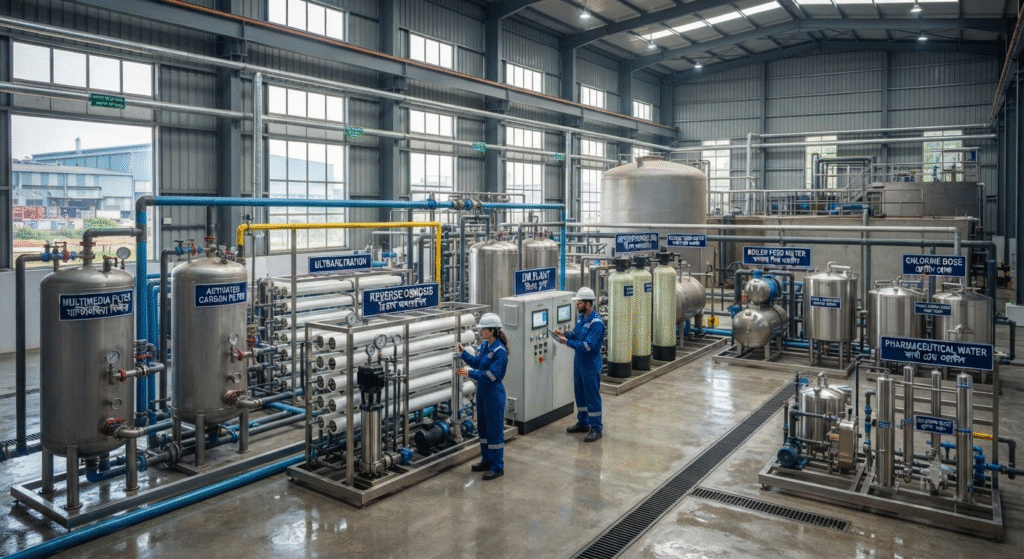
Why Industries in West Bengal Need Customized Water Treatment
West Bengal’s water challenges are diverse. Groundwater in parts of the Gangetic plains, including districts such as Murshidabad, Nadia, Malda and North 24 Parganas, has long been associated with arsenic contamination. Many areas also report high iron content, while coastal and delta regions such as South 24 Parganas face salinity and high total dissolved solids (TDS). Hardness is common in the western plateau belt around Bankura, Purulia and Asansol. Surface water from rivers and ponds brings turbidity, organic matter and seasonal variation.
On top of this, industries must meet product-quality standards and comply with discharge norms set by pollution control authorities. A generic plant either under-treats the water (causing scaling, product rejection or compliance problems) or over-treats it (wasting capital and running costs). Customization solves both problems.
How a Customized Water Treatment System Is Designed
Good design begins with data, not equipment. Every credible industrial water treatment plant in West Bengal should follow a structured process.
1. Water Quality Analysis
The first step is a detailed laboratory analysis of the raw water. Key parameters include pH, turbidity, TDS, hardness, iron, manganese, arsenic, chlorides, sulphates, silica, bacterial load, and for wastewater, BOD, COD and suspended solids. Because quality changes with season and source, samples from different periods give a far more reliable design basis than a single test.
2. Industry Requirements
The required output quality depends on the end use:
- Boilers and cooling towers need low hardness and silica to prevent scaling and corrosion.
- Food and beverage units need potable, taste-neutral and microbiologically safe water.
- Pharmaceutical and laboratory use needs high-purity water with very low conductivity.
- Textile and dyeing units need soft, iron-free water for consistent colour.
- Hospitality and institutions need safe drinking water at steady pressure.
3. Treatment Capacity
Capacity is calculated from peak and average daily demand, number of operating shifts, storage tank volume and expected future expansion. Sizing too small causes bottlenecks, while sizing too large raises both investment and maintenance costs. A modular design lets you add capacity later without rebuilding the plant.
4. Operational Needs
Practical constraints shape the final layout: available floor space, power supply and consumption, level of automation, manpower skill, maintenance access and the budget for chemicals and consumables. A plant that is easy to operate and service will perform better over its life than a theoretically perfect one that is hard to maintain.
Core Technologies in an Industrial Water Treatment Plant
A customized plant is a combination of stages. Each stage removes a specific category of impurity.
Pre-Treatment and Filtration
Pre-treatment protects downstream equipment and improves overall efficiency. Typical units include:
- Aeration and oxidation to convert dissolved iron and manganese into filterable particles.
- Pressure sand filters (PSF) to remove suspended solids and turbidity.
- Activated carbon filters (ACF) to remove chlorine, odour, colour and organic compounds.
- Iron removal filters (IRF) for high-iron groundwater, very common in the region.
- Multimedia filters, ultrafiltration (UF) and cartridge filters for finer polishing.
- Dosing systems for coagulants, antiscalants and disinfectants.
Water Softeners
Softeners use ion-exchange resin to replace calcium and magnesium (the causes of hardness) with sodium. They are essential ahead of boilers, heat exchangers, laundries and cooling systems, where scale reduces efficiency and shortens equipment life. Automatic regeneration with brine keeps operation hassle-free.
Reverse Osmosis (RO) Systems
Industrial RO pushes water through semi-permeable membranes at high pressure, removing dissolved salts, many heavy metals, bacteria and other contaminants. Brackish water RO suits moderate TDS, while seawater-grade membranes are used for very high salinity. For applications needing even higher purity, RO is often followed by electrodeionization (EDI) or a mixed-bed polisher to deliver demineralized (DM) water.
Disinfection
UV systems, chlorination or ozonation make sure treated water is microbiologically safe, especially for food, beverage, healthcare and drinking-water applications.
Wastewater Treatment: ETP and STP
Water treatment does not end at the inlet. Industries generate effluent that must be treated before reuse or discharge. An Effluent Treatment Plant (ETP) typically combines screening, equalization, chemical treatment and a biological stage (such as MBBR or activated sludge), followed by clarification and tertiary filtration. A Sewage Treatment Plant (STP) handles domestic wastewater from colonies, hotels and institutions. Many units also add a Zero Liquid Discharge (ZLD) or recycle loop that sends treated water back to utilities such as cooling towers, gardening and flushing, which cuts freshwater demand significantly.
Comparison of Key Treatment Technologies
| Technology | What It Removes | Best For | Key Consideration |
| Pressure Sand Filter | Suspended solids, turbidity | Pre-treatment for all industries | Needs periodic backwashing |
| Activated Carbon Filter | Chlorine, odour, colour, organics | Food, beverage, pre-RO protection | Media needs replacement over time |
| Iron Removal Filter | Iron, manganese | Groundwater with high iron | Often requires aeration first |
| Water Softener | Hardness (Ca, Mg) | Boilers, laundries, cooling | Uses salt for regeneration |
| Reverse Osmosis | Dissolved salts, TDS, heavy metals, bacteria | Drinking water, process water, DM feed | Generates reject water; needs pre-treatment |
| UV / Chlorination | Bacteria, viruses | Potable and food-grade water | Water must be clear for UV to work |
| ETP / STP | BOD, COD, solids, pollutants | Effluent compliance and reuse | Design depends on effluent characteristics |
Customized Solutions for Different Industries
The table below shows how treatment trains typically differ by sector. These are illustrative; the final design always depends on test results.
| Industry | Typical Water Challenge | Likely Treatment Train |
| Pharmaceutical and Healthcare | High purity, microbial control | PSF → ACF → Softener → RO → EDI/Mixed Bed → UV |
| Food and Beverage | Taste, safety, consistency | Aeration → PSF → ACF → RO → UV/Ozone |
| Textile, Jute and Dyeing | Iron, hardness, colour variation | IRF → Softener → ACF; ETP for effluent |
| Power and Steel | Scaling, corrosion, high volumes | Clarification → UF → Softener/DM → RO; cooling-water treatment |
| Hotels, Hospitals, Institutions | Safe drinking water, steady supply | IRF → PSF → ACF → RO → UV; STP for sewage |
| Tea and Agro Processing | Turbidity, organics | Filtration → Disinfection; ETP for process wastewater |
Practical Example 1: Iron and Arsenic-Affected Groundwater
A food-processing unit in a Gangetic-belt district draws from a borewell with high iron and traces of arsenic. A suitable design might use aeration, an iron removal filter, a sand filter and carbon filter, followed by RO and UV. The pre-treatment protects the membranes, while RO delivers consistent TDS and removes dissolved contaminants.
Practical Example 2: Boiler Feed in a Manufacturing Plant
A mid-size manufacturing unit with a steam boiler faces repeated scaling and frequent shutdowns because of hard water. Adding a dual-column automatic softener, with an RO stage where silica is a concern, reduces scaling, improves fuel efficiency and extends equipment life.
Practical Example 3: Coastal Region with High Salinity
A unit near the coastal belt receives water with high TDS and chlorides. Brackish water RO with proper antiscalant dosing and multimedia pre-filtration brings the water within process limits, while a reject-management plan keeps the system compliant.
Practical Example 4: Effluent Recycling
A textile processing unit in the Kolkata region installs an ETP with a biological stage and tertiary treatment, then reuses a large share of treated water in non-critical processes and cooling. The result is lower freshwater cost and easier regulatory compliance.
Standard Plant vs. Customized Plant
| Factor | Standard (Off-the-Shelf) Plant | Customized Plant |
| Design basis | Generic assumptions | Actual water analysis and process needs |
| Treatment efficiency | Often under- or over-treats | Matched to target quality |
| Operating cost | Higher due to inefficiency | Optimized chemical, power and water use |
| Scalability | Limited | Modular and expandable |
| Compliance | Uncertain | Designed around discharge and quality norms |
| Lifecycle value | Lower | Higher, with longer equipment life |
How to Choose the Right Water Treatment Company in West Bengal
With many water treatment companies in West Bengal to choose from, look beyond price. A reliable partner should:
- Insist on a proper water analysis before proposing a design.
- Explain why each stage is included, not just list equipment.
- Offer in-house design, supply, installation and commissioning.
- Use quality membranes, pumps, valves and instrumentation from reputable brands.
- Provide automation options, operator training and clear documentation.
- Offer annual maintenance contracts (AMC), spare parts and prompt service support.
- Be able to show experience across industries similar to yours.
A company that can deliver a complete water purification plant in West Bengal, from raw-water treatment through to effluent recycling, saves you the complexity of coordinating multiple vendors.
Why Choose Unilax for Customized Water Treatment
Unilax approaches every project as an engineering problem to be solved, not a product to be sold. The process begins with understanding your water source and process requirements, moves through design, supply, installation and commissioning, and continues with maintenance support so that the plant keeps performing long after handover. Whether you need a compact RO system, a softener for a boiler, an iron-removal plant or a complete ETP, the solution is sized and configured for your operation.
Maintenance and Long-Term Performance
Even the best-designed plant needs care. Routine tasks include scheduled backwashing and regeneration, timely replacement of filter media, cartridges and membranes, monitoring of pressure, flow and TDS, periodic membrane cleaning (CIP) and regular lab testing of treated water. Preventive maintenance is almost always cheaper than breakdown repair, and good records help spot problems before they become failures.
Frequently Asked Questions (FAQs
It is a treatment system designed specifically for your water source, quality targets, capacity and operating conditions, instead of a standard unit built to a generic specification.
The selection depends on a laboratory analysis of your raw water and the quality your process requires. A qualified engineer compares the two and recommends the right combination of filtration, softening, RO or other stages.
Cost varies widely with capacity, raw-water quality, technology, automation level and material of construction. A site-specific quotation after water testing is the only reliable way to get an accurate figure.
Conclusion
No two industries, and often no two sites, have identical water. Raw-water quality, process demands, capacity and day-to-day operations all shape what the right treatment plant looks like. A customized water treatment plant in West Bengal built on proper analysis delivers consistent quality, lower operating costs, regulatory confidence and equipment that lasts longer.
If you are planning a new installation or upgrading an existing system, speak with the engineering team at Unilax for a water assessment and a solution designed around your needs.