
Introduction
Water is simultaneously a raw material, a coolant, a cleaning agent and a utility. Poor water quality quietly reduces output in steel plants, jute mills, pharmaceutical units, food processors, textile dyeing houses and power stations. Scale chokes boilers, iron stains products, dissolved salts corrode pipes and contaminated process water fails quality audits.
Regional water conditions and tightening environmental compliance further sharpen the challenge for the manufacturers across West Bengal. West Bengal’s industrial water treatment plants, when properly designed, protect equipment, stabilise product quality, reduce utility costs, and ensure operations stay within regulatory limits.
This guide explains how industrial water treatment works, what technologies are used, what water quality your process needs and how to choose the right system. Whether you are constructing a new facility or upgrading an ageing plant, it will help you ask better questions of any water treatment partner.
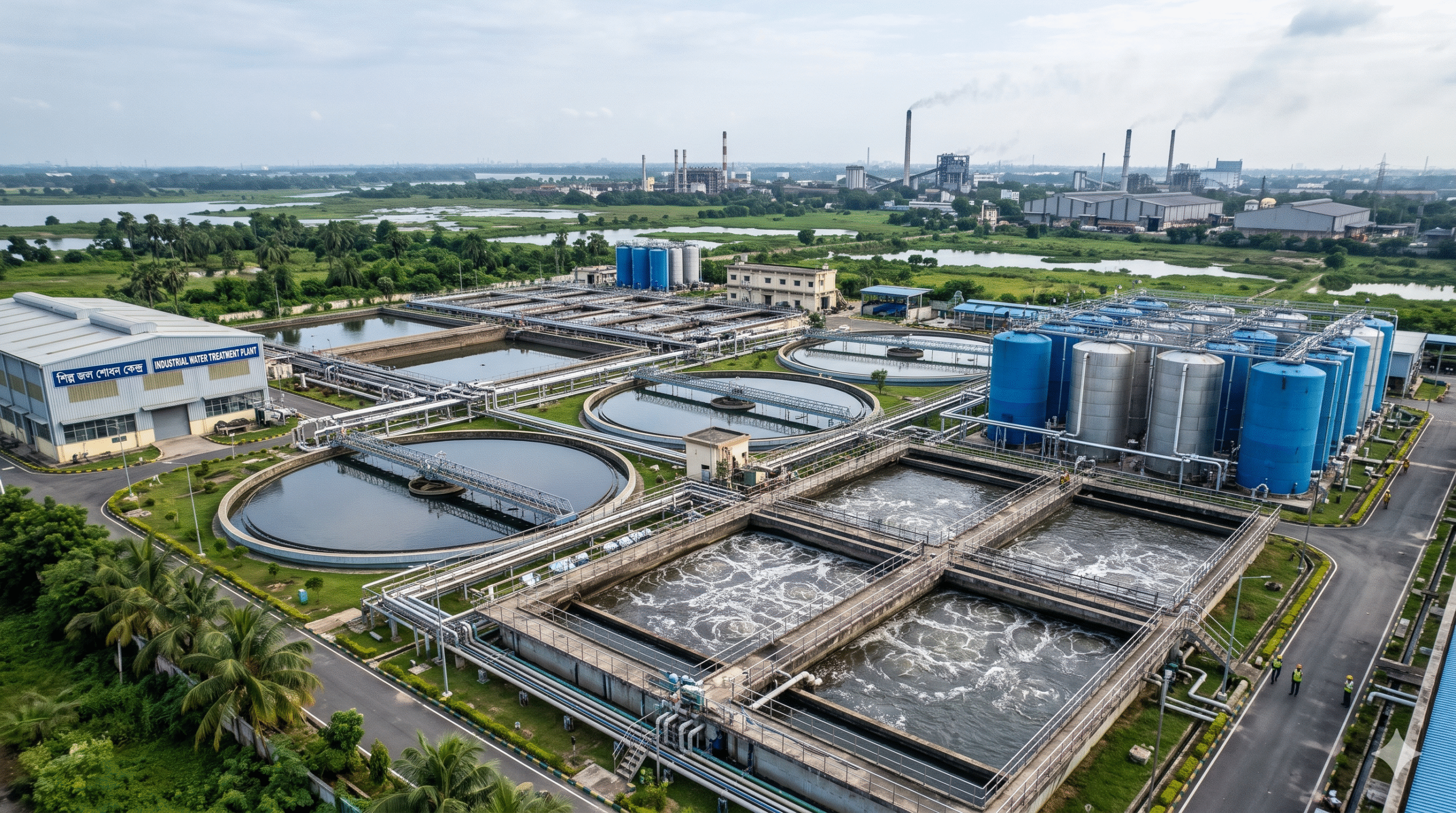
Why Water Treatment Matters for Industries in West Bengal
West Bengal has a diverse industrial base: engineering and steel in the Durgapur–Asansol belt, jute and textiles along the Hooghly, leather and chemicals around Kolkata, tea and food processing in the north, and a growing pharma and packaged beverage sector. Each draws on water with very different characteristics.
Common source-water challenges in the region include:
- High iron content in groundwater, which causes staining, fouling and bacterial growth.
- Arsenic and fluoride in groundwater in certain districts, which matter for food, beverage and pharma uses.
- Salinity and high TDS in coastal and delta-adjacent areas.
- Turbidity and suspended solids in surface water, especially after monsoon.
- Hardness that forms scale in boilers, heat exchangers and cooling towers.
Because source water varies from one district to another, and sometimes from one borewell to the next, a water test must come before any equipment decision.
Understanding Industrial Water Treatment: The Basic Flow
Most plants combine several stages. A typical treatment train looks like this:
- Raw water collection and storage with equalisation.
- Pre-treatment: aeration, chemical dosing, clarification, sand and carbon filtration.
- Softening or demineralisation to remove hardness and dissolved ions.
- Membrane treatment: ultrafiltration (UF) and reverse osmosis (RO).
- Polishing and disinfection where needed.
- Distribution to boilers, cooling systems, process lines or utilities.
A separate effluent treatment and recycling loop usually follows, so that used water is treated and, where possible, reused.
Key Industrial Water Treatment Processes
1. Pre-Treatment and Filtration
Pre-treatment protects everything downstream. Skipping it is the most common reason membranes and softeners fail early.
- Aeration and oxidation convert dissolved iron and manganese into particles that can be filtered.
- Coagulation and flocculation bind fine suspended particles into larger flocs.
- Pressure sand filters (PSF) remove suspended solids and turbidity.
- Activated carbon filters (ACF) remove chlorine, organics, colour and odour.
- Iron removal filters (IRF) use specialised media for iron and manganese.
- Cartridge and bag filters act as a last safety barrier before membranes.
Practical example: A food processing unit drawing borewell water with high iron was seeing yellow discolouration and RO membrane fouling. Adding aeration, an iron removal filter and a carbon filter ahead of the RO typically resolves this and extends membrane life considerably.
2. Water Softening
Hardness, caused by calcium and magnesium, forms scale on heat-transfer surfaces. Even a thin layer of scale reduces boiler and heat exchanger efficiency and raises fuel consumption.
A softener plant uses cation exchange resin to swap calcium and magnesium for sodium. When the resin is exhausted, it is regenerated with brine.
- Best suited for: boiler feed pre-treatment, laundry and textile processing, cooling tower make-up, and as RO pre-treatment.
- Limitation: it removes hardness but does not reduce total dissolved solids.
3. Reverse Osmosis (RO)
Reverse osmosis pushes water through a semi-permeable membrane at high pressure. It rejects most dissolved salts, along with bacteria, organics and many contaminants.
- Removes a large share of TDS, hardness, silica, heavy metals and arsenic.
- Delivers consistent, high-purity water for process and boiler use.
- Produces a reject stream that must be managed; recovery can be improved with staged design and reject recycling.
- Needs good pre-treatment, regular cleaning (CIP) and antiscalant dosing.
Practical example: A pharmaceutical or beverage unit needing low-TDS water often uses UF followed by a two-pass RO, then polishing with electrodeionisation (EDI) or mixed-bed ion exchange.
4. Ultrafiltration (UF)
UF membranes remove suspended solids, colloids, bacteria and some viruses. In industry, UF is widely used as a pre-treatment step ahead of RO because it delivers stable feed quality even when raw water turbidity swings.
5. Demineralisation (DM) and Ion Exchange
DM plants use cation and anion resins (often with a mixed bed) to remove dissolved ions and produce very low conductivity water. This is common for high-pressure boilers, power plants and electronics or chemical processes.
6. Disinfection and Purification Technologies
Where microbiological safety matters, plants add one or more of:
- Chlorination or chlorine dioxide for residual protection.
- Ultraviolet (UV) disinfection, a chemical-free option with no taste or by-products.
- Ozonation for strong oxidation and disinfection.
- Microfiltration or sterile filtration for pharma and beverage lines.
Together, these make up a complete industrial water purification plant.
7. Cooling Water and Boiler Water Conditioning
Even treated water needs ongoing conditioning inside the system. Cooling towers require control of scale, corrosion and biological growth through dosing and blowdown management. Boilers need oxygen scavengers, pH control and regular TDS monitoring.
Comparison Table: Core Water Treatment Technologies
Technology | Main purpose | Removes | Does not remove | Typical use |
Pressure sand filter | Clarification | Suspended solids, turbidity | Dissolved salts | Pre-treatment |
Activated carbon filter | Dechlorination, organics | Chlorine, colour, odour, organics | Dissolved salts, hardness | Pre-treatment, food and beverage |
Iron removal filter | Iron and manganese control | Iron, manganese | TDS | Borewell sources |
Water softener | Hardness control | Calcium, magnesium | TDS, silica | Boilers, textiles, cooling |
Ultrafiltration | Fine particle removal | Colloids, bacteria, turbidity | Dissolved salts | RO pre-treatment, reuse |
Reverse osmosis | Desalination | TDS, hardness, most ions, microbes | Some dissolved gases | Process, boiler, beverage |
DM / mixed bed | Deionisation | Nearly all ions | Organics, bacteria | High-pressure boilers, labs |
UV disinfection | Microbial control | Bacteria, viruses | Chemicals, salts | Final polishing |
Industrial Water Quality Requirements by Application
Water quality needs differ widely by use. The table below gives general indicative guidance; always confirm specific limits against your equipment manufacturer’s recommendations, your product standards and applicable regulations.
Application | Key concerns | Typical treatment approach |
Low-pressure boilers | Hardness, silica, oxygen, TDS | Softener or RO, deaeration, chemical dosing |
High-pressure boilers / power | Very low conductivity, silica | RO plus DM or EDI |
Cooling towers | Scale, corrosion, biofouling | Softening or RO make-up, dosing, blowdown control |
Food and beverage | Safety, taste, colour, microbes | Filtration, carbon, RO, UV, as per food-safety standards |
Pharmaceutical | Purity, endotoxins, microbial limits | UF, RO, EDI, validated distribution |
Textile and dyeing | Hardness, iron, colour consistency | Iron removal, softening, RO for sensitive shades |
Leather and tanning | Salinity, chromium in effluent | Pre-treatment, effluent treatment, reuse |
Steel and engineering | Large volumes, cooling, scaling | Clarification, filtration, softening, recycling |
For drinking-water-grade applications, the BIS standard IS 10500 is the usual reference. For process and boiler water, equipment makers and industry standards set the limits.
Compliance and Sustainability
The State Pollution Control Board and central regulations enforce environmental norms for industries in West Bengal, including discharge standards and in many cases, zero liquid discharge (ZLD) or recycling expectations for certain sectors. Water treatment should therefore be integrated with the effluent handling.
Benefits of a well-planned reuse strategy include:
- Lower freshwater and groundwater dependence.
- Reduced effluent discharge and compliance risk.
- Savings through recovered water and lower chemical use.
- A stronger sustainability and ESG profile.
It is wise to confirm current permit and discharge requirements for your sector and location with the relevant authority before finalising design.
Why Customisation Matters: Choosing the Right System
No two industries, or even two plants in the same industry, have the same water. A customized water treatment plant in West Bengal is designed around your source water, process needs, volume and budget, rather than a standard catalogue model.
A poorly matched system leads to:
- Frequent membrane or resin replacement.
- Boiler scaling and unplanned shutdowns.
- Product rejection and quality complaints.
- High reject water and chemical costs.
- Compliance trouble.
Factors to Consider Before You Invest
- Source water analysis: TDS, hardness, iron, silica, turbidity, chlorides, arsenic, microbial load. Test across seasons if possible.
- Required output quality: the specification your process actually needs, not a generic “pure water” target.
- Flow rate and peak demand: design for realistic peaks plus a margin for growth.
- Recovery and reject handling: how much water you can reclaim and where the reject goes.
- Energy use and footprint: high-pressure pumps drive operating cost; space may be limited.
- Automation and monitoring: online sensors, PLC controls and alarms reduce manual errors.
- Operating cost, not just capex: chemicals, power, membranes, resin and manpower over five to ten years.
- Service support: spares availability, response time and operator training.
What to Look for in Water Treatment Companies in West Bengal
When comparing water treatment companies in West Bengal, look beyond price:
- Experience with your specific industry and water type.
- A willingness to carry out water testing and pilot or bench trials.
- Transparent design basis, with clear guaranteed outputs.
- Quality components and membranes from reputed manufacturers.
- In-house engineering, installation and commissioning capability.
- After-sales service, AMC options and remote monitoring.
- References from similar installations you can verify.
A good partner will ask many questions about your process before quoting. That is a positive sign.
Maintenance Best Practices
- Log pressure, flow, conductivity and recovery daily to catch trends early.
- Backwash and regenerate on schedule, not only when problems appear.
- Clean RO membranes (CIP) when normalised performance drops, rather than waiting for failure.
- Calibrate sensors and dosing pumps regularly.
- Re-test raw water periodically, since source quality changes with season and borewell condition.
- Train operators and keep critical spares on site.
Practical Scenarios
Boiler-dependent manufacturing unit: Hard borewell water causes repeated scaling. A softener or RO ahead of the boiler, with deaeration and dosing, protects tubes and lowers fuel use.
Beverage or packaged-water facility: Multi-media filtration, carbon, UF, RO and UV deliver consistent taste and safe microbial quality.
Textile or dyeing house: Iron and hardness cause uneven shades. Iron removal plus softening, with RO for sensitive processes, improves colour consistency and reduces rework.
Large engineering or steel facility: Clarified and filtered water for cooling, with recycling of blowdown, reduces fresh water intake significantly.
Frequently Asked Questions (FAQs)
Q1. What is an industrial water treatment system?
It is a system for cleaning and conditioning water for industrial use, removing suspended solids, dissolved salts, hardness, metals and microorganisms in order that the water meets the requirements of boilers, cooling systems, processes or discharge standards.
Q2. Why is water treatment important for industries in WB?
Groundwater and surface water in the state may contain iron, hardness, salinity and in some areas, arsenic. Treatment protects equipment and output against scaling, corrosion, product defects and compliance issues caused by untreated water.
Q3. Water Softening vs. Reverse Osmosis – What’s the Difference?
Softening removes only hardness (calcium and magnesium) through ion exchange. RO removes a wide range of dissolved salts, including hardness, as well as many other contaminants. Softeners are often used upstream of RO or for less demanding applications.
Q4. How do I know what treatment system my industry needs?
Start with a detailed water analysis and a precise definition of the quality needed by your process. Flow rate, budget, space and discharge rules are important too. A qualified provider will suggest a combination of technologies, not just one unit.
Conclusion
A plant for industrial water treatment in West Bengal is not a luxury utility but a bedrock for seamless production, equipment longevity and regulatory confidence. The right water analysis will help determine the right mix of filtration, softening, reverse osmosis and purification to protect your assets and keep costs predictable.
By selecting the right partner, demanding a design that focuses on their own water and process, and maintaining the system properly, industries can increase efficiency and move toward sustainable water use.
Are you installing a new plant, or are you upgrading an existing plant? Contact the Unilax team for a water assessment and system specific to your industry.