
RO Water Treatment Plant vs Conventional Water Purification: Which Is Better for Industries?
Water is a core input for most industrial operations. It is used in boilers, cooling towers, food processing, pharmaceutical formulation, textile dyeing, chemical manufacturing and more. Poor-quality water leads to scaling, corrosion, equipment failure, product defects and regulatory trouble. This is why choosing the right Industrial Water Treatment Plant in West Bengal is a strategic decision, not just a utility purchase.
The two most common options are Reverse Osmosis (RO) systems and conventional water purification (coagulation, sedimentation, filtration and disinfection). Each has strengths, limits and ideal use cases. This guide compares them so your business can choose with confidence.
Why Water Treatment Matters for Industries in West Bengal
West Bengal’s industrial belt, spanning Kolkata, Howrah, Hooghly, Durgapur, Haldia, Asansol and Siliguri, draws on varied water sources: groundwater, river water and municipal supply. Common quality challenges include:
- High iron content in groundwater across many districts
- Elevated Total Dissolved Solids (TDS) and hardness in some areas
- Arsenic contamination in parts of the Gangetic delta
- Turbidity and organic load in surface and river water
- Salinity in coastal and tidal regions near Haldia and the Sundarbans
Because source water differs so much by location, a single standard solution rarely works. That is why many businesses look for a Customized Water Treatment Plant in West Bengal designed around their own water analysis and process needs.
What Is a Conventional Water Purification System?
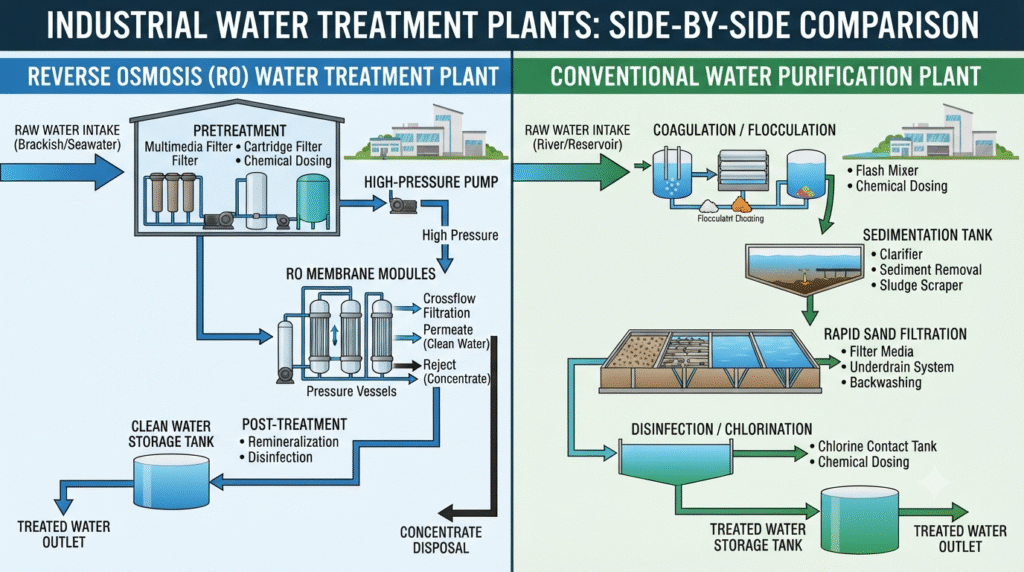
The traditional treatment employs physical and chemical processes to remove suspended and some dissolved impurities. A train normally comprises:
- Aeration / Oxidation : Converts dissolved iron and manganese into filterable particles.
- Coagulation and Flocculation: Chemicals such as alum or PAC are added to bind together fine particles into larger flocs.
- Sedimentation / Clarification: Flocs fall out of the water.
- Filtration: Pressure sand filters, multigrade filters and activated carbon filters remove any remaining particles, colour, odour and chlorine.
- Softening (Ion Exchange): Removes hardness (Ca and Mg).
- Disinfection: Microbial contamination is controlled by chlorination, UV or ozone.
How It Works
The traditional systems are based on settling, adsorption, filtration and ion exchange. They are very effective in removing turbidity, iron, colour, odour and hardness but have limited ability to remove dissolved salts.
What Is an RO Water Treatment Plant?
Reverse osmosis forces water at high pressure through a semi-permeable membrane. The membrane allows water molecules to pass while rejecting most dissolved salts, heavy metals, bacteria, viruses and organic molecules.
How It Works
A typical industrial RO plant includes:
- Pre-treatment (multigrade filter, activated carbon, antiscalant dosing, micron cartridge filters)
- High-pressure pump
- RO membrane skid
- Permeate (treated water) and reject (concentrate) streams
- Post-treatment (pH correction, UV, remineralization if needed)
RO typically removes 95-99% of dissolved solids, making it the preferred technology where low-TDS, high-purity water is required.
Detailed Comparison: RO vs Conventional Water Purification
| Parameter | RO Water Treatment Plant | Conventional Water Purification |
| Working Principle | Pressure-driven membrane separation | Coagulation, sedimentation, filtration, ion exchange, disinfection |
| TDS Removal | Very high (95-99%) | Low to negligible (except via demineralization/ion exchange) |
| Suspended Solids / Turbidity | Needs pre-treatment; membranes are sensitive to fouling | Very effective |
| Iron and Manganese | Requires pre-treatment before RO | Effectively removed by oxidation and filtration |
| Hardness | Removed to a large extent | Removed via softeners |
| Heavy Metals (e.g., Arsenic, Lead) | Highly effective | Limited unless specialized media is used |
| Microbial Removal | Excellent barrier; usually paired with UV | Depends on disinfection stage |
| Output Water Quality | High purity, consistent | Good for general-use water; variable for dissolved contaminants |
| Water Recovery / Wastage | 50-85% recovery; reject stream is generated | Higher recovery; backwash water is the main waste |
| Capital Cost | Higher | Lower to moderate |
| Operating Cost | Energy, membranes, antiscalants, cleaning chemicals | Chemicals, media replacement, labor |
| Maintenance | Membrane cleaning (CIP), antiscalant dosing, regular monitoring | Backwashing, media replacement, chemical dosing |
| Membrane / Media Life | Membranes typically 2-5 years, depending on feed water and care | Media typically lasts several years with proper backwashing |
| Footprint | Compact skid-mounted systems | Larger, especially with clarifiers and settling tanks |
| Best Suited For | Pharma, boiler feed, electronics, beverages, high-TDS water | Cooling makeup, process water, pre-treatment, high-turbidity sources |
| Automation Potential | High (PLC/SCADA integration) | Moderate to high |
Water Quality: Which Delivers Better Results?
RO delivers superior water quality for dissolved contaminants. If your process needs low conductivity, low hardness or tight compliance limits, RO is hard to beat.
Conventional treatment is better at handling raw water with high turbidity, iron or organic load. It cannot, however, reduce dissolved salts to the levels many industries require.
In practice, the strongest systems combine both: conventional pre-treatment protects the RO membranes, and RO delivers the final polish.
Industrial Applications
Where RO Is the Better Fit
- Pharmaceuticals and Healthcare: Purified water for formulations and cleaning
- Boilers and Power Plants: Low-TDS feed water to prevent scaling and carryover
- Food and Beverage: Consistent taste and compliance
- Electronics and Semiconductors: Ultra-pure water requirements
- Textiles and Dyeing: Soft, low-TDS water for color consistency
- Desalination: Coastal and brackish water sources
Where Conventional Treatment Is the Better Fit
- Cooling Tower Makeup Water: Moderate quality is often sufficient
- Construction and Civil Use: Turbidity and iron removal
- Steel and Metal Processing (non-critical uses): General process water
- Municipal-Style Supply for Campuses and Townships
- Pre-Treatment for Any Advanced System
Maintenance Requirements
RO systems should be handled with care. If feed water quality drops or antiscalant dosing is forgotten, membranes will foul and scale. Routine tasks involve:
- Monitoring of differential pressure, permeate flow and conductivity
- Regular Clean-In-Place (CIP) cycles
- Changing cartridge filters and eventually membranes
- Retaining pre-treatment performance
- Traditional systems are usually more tolerant. Maintenance focus is on:
- Backflushing filters
- softener resin regeneration
- Chemical dosing refill and calibration
- Changing media through time
In both cases, the reliable service support is important. We work with established Water Treatment Companies in West Bengal who provide AMC (Annual Maintenance Contract) services which helps to maintain high uptime.
Operating Costs: A Realistic View
Capital cost is only part of the picture. Evaluate total cost of ownership over 5-10 years:
- RO: Higher energy use (high-pressure pumping), membrane replacement, antiscalant and cleaning chemicals, and reject water management. Savings often come from reduced boiler blowdown, less equipment scaling and better product quality.
- Conventional: Lower energy needs, but ongoing chemical use, media replacement and sludge handling. Savings come from simpler operation and lower upfront investment.
A cheaper plant that fails to meet your water quality target costs more in downtime, rework and equipment damage than a properly specified one.
Environmental and Regulatory Considerations
- RO produces a reject stream with concentrated salts. Plan for recovery, reuse (for gardening, cooling or flushing) or compliant disposal.
- Conventional systems generate sludge and backwash water that also need proper handling.
- Industries must follow West Bengal Pollution Control Board (WBPCB) and Central Pollution Control Board norms. Many facilities also adopt Zero Liquid Discharge (ZLD) or water-reuse strategies to cut freshwater dependence.
How to Choose the Right Water Treatment Solution
Follow this practical framework:
- Test Your Raw Water: Get a full analysis covering pH, TDS, hardness, iron, turbidity, chlorides, silica, arsenic and microbial load.
- Define Your Output Requirement: Different processes need different water grades. Boilers, pharma and cooling towers have very different specifications.
- Estimate Capacity: Calculate peak and average daily demand, plus future expansion.
- Consider Water Source Variability: Seasonal changes in groundwater or river water may need a flexible design.
- Assess Space, Power and Manpower: Consider footprint, energy availability and operator skill.
- Compare Lifecycle Cost, Not Just Capex: Include consumables, power, labor and downtime risk.
- Check Compliance Needs: Ensure the design meets pollution control and industry standards.
- Choose an Experienced Partner: Look for engineering depth, installation track record, commissioning support and after-sales service.
Often, the Answer Is a Hybrid System
Most industrial plants use pre-treatment (aeration, filtration, softening) plus RO, sometimes followed by demineralization (DM) or Electrodeionization (EDI) for very high purity. A Customized Water Treatment Plant in West Bengal built on this integrated approach delivers the right quality at the lowest sustainable cost.
Why Work with a Specialist Provider like Unilax
There isn’t a universally applicable answer to water treatment. Unilax designs and delivers industry specific solutions from small RO systems to large integrated treatment trains. As a Water Purification Plant in West Bengal Solutions provider, Unilax assists the clients in :
- Water analysis and feasibility assessment
- System adaptation and process design
- Supply, fitting and putting into operation
- Automation And Control
- Operator training and AMC support
This end-to-end approach enables industries to achieve reliable water quality and control long-term operating costs.
Frequently Asked Questions (FAQs)
Q1. Is RO superior to the traditional water purification industries?
Neither is superior to the other. RO is very good for removing dissolved salts and producing high purity water, conventional treatment is best for removing turbidity, iron and suspended solids. Most industries find a blend of both beneficial.
Q2. Can a RO plant work without pre-treatment?
Rarely. High iron, turbidity, chlorine or hardness in feed water can quickly foul or damage RO membranes. Pre-treatment is crucial for the life of the membrane and stable performance.
Q3. Which industries need RO water the most?
Reliable RO operation in pharmaceuticals, power and boiler plants, food and beverage, electronics, textile processing and chemical industries commonly requires low-TDS water.
Q4.How much water is wasted in RO plant of industry?
The amount of feed water that is recovered as permeate in an industrial RO system is typically between 50 and 85 percent, depending on the design of the system, the quality of the feed water, and the rate of recovery. The reject stream can often be reused for non-critical applications like cooling, washing or landscaping.
Q5. When to replace RO membranes?
Membranes generally last 2-5 years. Life depends on feed water quality, pretreatment performance, cleaning practices and operating conditions.
Q6. Is a customised water treatment plant worthwhile?
“Yeah. The custom plant is designed to match your specific raw water profile, capacity and process requirements, eliminating over design, lowering operating costs and increasing reliability over a generic off the shelf system.
Q7. How to select water treatment companies in West Bengal?
Look for proven industrial installations, in-house design capability, quality components, transparent costing, commissioning support and responsive after-sales service. Request case studies and references of clients in your industry.
Conclusion
The decision between RO and conventional water purification is based on your raw water quality, your process requirements and your budget. Conventional treatment is cost effective for removal of suspended solids, iron, colour and hardness. RO is the technology of choice when dealing with dissolved solids, heavy metals and strict purity standards. A well-engineered combination is often the best performer and offers the best value over the life cycle for many industrial users.
Prior to your investment, initiate a thorough water analysis and work with an experienced partner to tailor a system to your specific needs. If you are planning for Industrial Water Treatment Plant in West Bengal, Unilax can help you evaluate your options and build a reliable, efficient and Compliant Solution.