
Choosing an industrial water purification system in West Bengal is a long term decision. The right system protects your equipment, supports product quality and keeps you on the right side of discharge and quality norms. The latter leads to frequent breakdowns, high running costs and unnecessary downtime.
This guide reviews the main checkpoints for factory owners, plant managers and procurement teams.
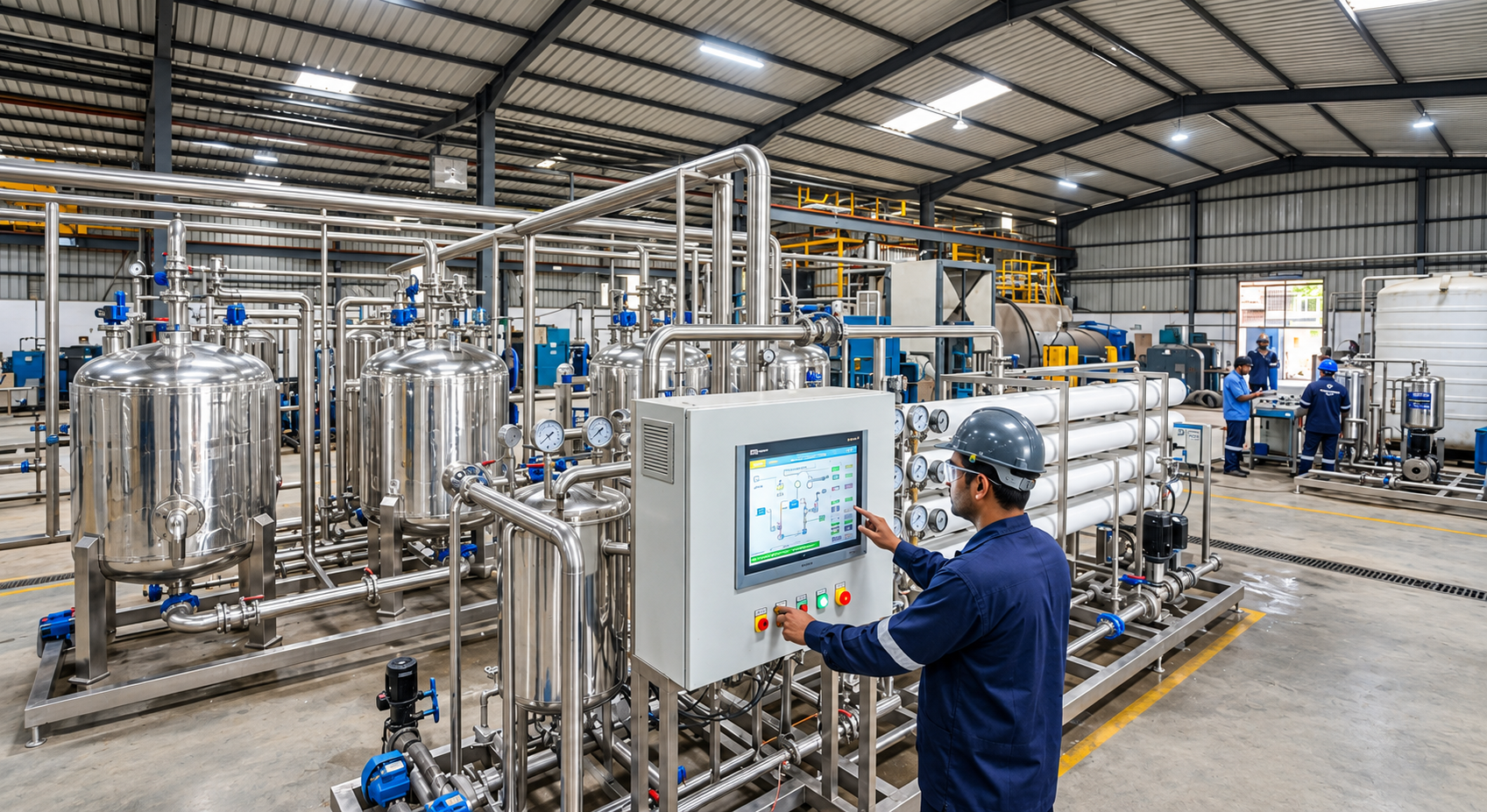
Start With Your Water Demand
Before you speak to any supplier, work out how much treated water you actually need.
- Daily consumption: Add up process water, boiler feed, cooling tower make-up, cleaning and drinking or utility use.
- Peak vs. average flow: Systems are sized for peak demand, so note shift patterns and seasonal swings.
- Recovery and reuse: If you plan to recycle water, this affects both the design and the volume of reject to be managed.
- Future growth: Estimate where production will be in a few years, not just today.
Test Your Raw Water First
Never choose equipment before you know what you are treating. Water quality varies widely across West Bengal, depending on the source (groundwater, surface water or municipal supply) and the location.
Get a water analysis done by a recognised laboratory. It typically covers:
- Total dissolved solids (TDS), hardness, alkalinity, pH
- Iron, manganese, chlorides, sulphates, silica
- Turbidity, suspended solids and microbial load
Water quality can also change with season, so a single sample may not tell the whole story. Share the full report with every supplier you approach so their proposals are comparable.
Define the Output Quality You Need
Different water for different applications. Boiler feed, electronics, textiles, food or pharmaceutical processes and general utility use have different requirements. List the parameters of interest for each use point. A good design uses only the amount of water the process requires and nothing more.
RO vs. Conventional Filtration
Both have their uses, and many plants use both.
Conventional filtration (media filters, activated carbon, softeners, iron removal) primarily removes suspended solids, iron, chlorine and hardness. It is suitable for applications where dissolved salts are not the primary concern.
Reverse osmosis (RO) is a semi-permeable membrane that removes dissolved salts and many other contaminants. It is appropriate for cases where the dissolved solids need to be reduced significantly . It does create a reject stream that needs to be properly disposed of .
If very low conductivity is required, for example in some boiler or process applications, then other stages such as demineralisation might be considered. This is not a standard template, but depends on your water test and process needs.
Don’t Skip Pretreatment
Pre-treatment protects all downstream. In particular, if iron, suspended solids, chlorine or hardness are not addressed first, membranes can foul or scale quickly. Pretreatment may involve sedimentation, multimedia filtration, carbon filtration, softening, iron removal and anti-scalant dosing depending on your water. Ask any supplier to explain why each stage is required.
Understand the Operating Costs
The purchase price is only part of the picture. Ask suppliers to explain, in general terms, what drives ongoing costs:
- Energy: Pumps, especially high-pressure RO pumps, are a major consumer.
- Chemicals: Anti-scalants, cleaning chemicals, regenerants and disinfectants.
- Membranes and consumables: Membranes, cartridges, filter media and resins need periodic replacement.
- Manpower: Operators, laboratory checks and supervision.
- Reject handling: Managing or treating the concentrate.
Request a clear operating-cost breakdown in writing so you can compare options over the system’s life.
Plan for Maintenance and Spares
What does a typical maintenance schedule look like? How fast can spares be supplied? Verify that the supplier offers annual maintenance contracts, operator training and service support within West Bengal. The easy access to membranes, dosing components and instrumentation greatly reduces downtime.
Check Scalability
Ask whether the system can be expanded by adding skids or stages, and whether the civil layout, piping and electrical load allow for it. Modular designs are often easier to scale as production grows.
Confirm Compliance
Your plant may have to meet water quality, effluent discharge and groundwater use requirements. That depends on your industry and where you are. Check the relevant rules with the concerned authorities e.g. West Bengal Pollution Control Board. Ask the supplier as to what standards their design conforms to and what documents are available.
Selection Checklist
Selection Factor | What to Check | Why It Matters | Questions to Ask |
Water demand | Daily, peak and future volumes | Prevents under- or oversizing | How did you size the system for our peak flow? |
Raw water quality | Lab report, seasonal variation | Drives the whole process design | Which test parameters did you base the design on? |
Output quality | Target values per use point | Avoids over-treating or falling short | Which output parameters are you designing for? |
Technology | RO, filtration, softening, DM | Matches treatment to the need | Why this combination for our water? |
Pretreatment | Stages and protection of membranes | Extends membrane life | What happens if raw water quality changes? |
Operating costs | Energy, chemicals, consumables, labour | Determines lifetime cost | Can you provide a written running-cost breakdown? |
Maintenance and spares | Service plan, spares availability | Limits downtime | What is your response time and spare supply process? |
Scalability | Expansion provisions | Supports growth | Can capacity be added later, and how? |
Compliance | Applicable standards and documents | Reduces regulatory risk | Which standards does the design follow? |
How to Compare Companies and Quotations
Many water treatment companies in West Bengal will quote for the same requirement, but quotes are only comparable if the scope is the same. Compare:
- The treatment stages, the components and their specifications
- What is included (installation, commissioning, training, civil works)
- Warranty terms and what they cover
- After-sales and maintenance support
- References you can verify independently
Visit an existing installation if possible. Be cautious of proposals that skip the water analysis, or that promise results without referring to your actual water data.
Where Unilax Fits In
Unilax Industries Pvt. Ltd. is a Kolkata-based company that is one option you can contact when evaluating an Industrial Water Purification System in West Bengal. According to its website, it offers RO plants, DM plants, dosing systems, iron removal plants, water softeners, effluent and sewage treatment plants, and RO spares, along with design-to-commissioning turnkey execution and after-sales maintenance support.
As with any supplier, confirm the scope, specifications and applicable standards directly with them.
Questions to Ask Before You Buy
- Have you reviewed our water test report, and is the design based on it?
- What are the expected output parameters, and how are they verified?
- What is the pretreatment scheme, and why?
- What consumables will we replace, and how often?
- What does your maintenance and spares support look like locally?
- Can the plant be expanded later?
- Which regulations and standards apply to our facility?
Conclusion
In West Bengal, water treatment plants are all about preparation. Know your demand, test your raw water, define your output needs and compare suppliers on the same scope. Good water treatment equipment in West Bengal is as much a question of service and spares as it is of the hardware.
Once you are ready to start shortlisting, send your water report and requirements to a few suppliers including Unilax, and ask for a detailed proposal.
Frequently Asked Questions
Why do I need to test my water before I purchase a system?
The design of the treatment depends on what is in the water. Without a test report, suppliers can only guess and risk under-sizing, over-sizing or offering an ineffective system.
Is RO always required for a factory?
No. If the main problems are suspended solids, iron or hardness, conventional treatment may be enough. RO is used when you need to reduce dissolved salts.
What has the biggest impact on running costs?
Key Drivers: Energy, chemicals, membranes and consumables, labour. The exact mix will depend on your water quality, system size & usage.
How often do you have to change the membranes?
It is contingent upon the quality of the feed water, pre-treatment, operating conditions and maintenance. Consult the supplier for specific guidance for your design.