
Water Treatment Choices It is rare that equipment west bengal is a one size fits all decision. The water we get is from different places in different districts. Iron, hardness, salinity, turbidity and, in some places, arsenic can all affect which system is appropriate for a site. This guide covers the main types of equipment and how to compare options before requesting quotes.
Main Types of Water Treatment Equipment
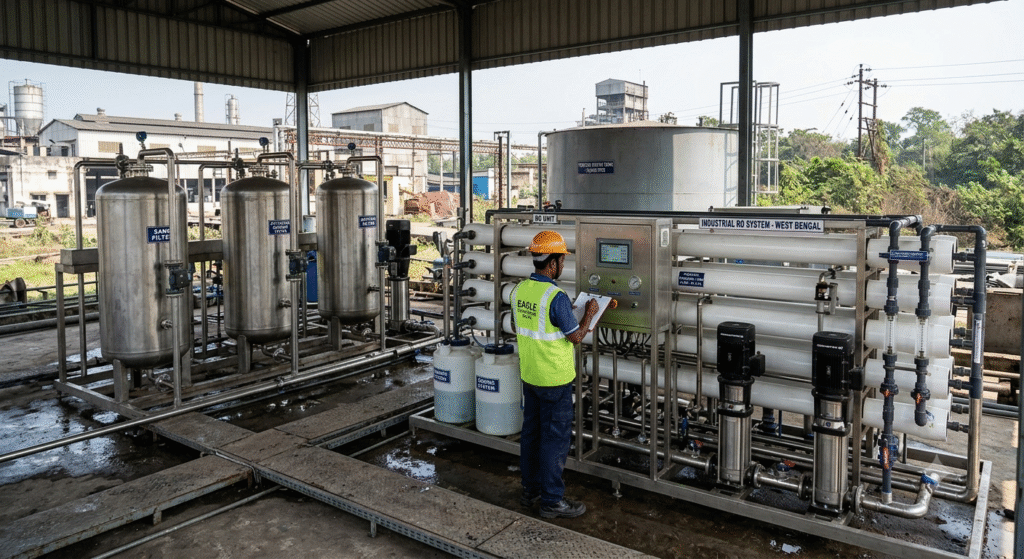
Most Industrial Water Purification System west bengal setups combine several stages rather than relying on one machine. The table below summarises the common building blocks.
Equipment Type | What It Does | Common Applications | Things to Consider |
Sand filter | Removes suspended solids and turbidity | Pretreatment for most plants | Backwash frequency, media condition |
Activated carbon filter | Reduces chlorine, odour, colour and some organics | Food and beverage, hotels, RO pretreatment | Carbon replacement schedule |
Multimedia filter | Uses layered media for finer particle removal | Industrial process water, boiler feed pretreatment | Flow rate, backwash water use |
Water softener | Removes hardness (calcium, magnesium) through ion exchange | Boilers, laundries, hotels, cooling systems | Regeneration cycle, salt use |
Ultrafiltration (UF) | Membrane filtration for fine particles and microorganisms | Drinking water, RO pretreatment, food processing | Membrane cleaning, feed quality |
Reverse osmosis (RO) | Reduces dissolved salts and many contaminants | Pharma, beverages, textiles, institutions | Recovery rate, reject water, membrane life |
Iron removal and dosing systems | Treat iron and condition water chemically | Borewell water, boiler and cooling circuits | Dosing accuracy, chemical handling |
What Each Stage Is Used For
Filter units. Many plants have sand, activated carbon and multimedia filters as the front end. This industrial water filtration equipment protects downstream membranes and softeners from chlorine and solids. Not doing so often shortens the life span of expensive components.
Water softener. Hard water deposits scale in boilers, heat exchangers and pipes. Softeners are used to reduce this problem by exchanging hardness ions, which is why they are common in laundries, hotels and boiler houses.
Ultrafiltration and RO . UF removes fine particulates and many microorganisms. RO goes a step further to remove dissolved salts. They are often used together with UF to protect the RO membranes.
Equipment for pre-treatment. The raw water is prepared for the main process by aeration, iron removal, chemical dosing and clarification. When borewell water contains iron, this stage is often the difference between a plant that runs smoothly and one that clogs.
Start With a Raw Water Test
Testing water first, then selecting equipment. A lab report of your actual source will tell you what contaminants need treatment. A plant designed without one is a guess.
Typical parameters are pH, TDS, hardness, iron, chlorides, turbidity, alkalinity and microbiological quality. If your source changes or the seasons change, test again, as quality can vary through the year. Send the full report to all suppliers you contact, so that they can make comparable proposals.
Plan Capacity Carefully
Capacity should reflect real demand, not a rough guess. Consider:
- Daily consumption and peak-hour demand
- Number of operating shifts
- Storage tank volume, which can reduce the required flow rate
- Reject or backwash water, since net output is lower than feed
- Future expansion
Undersized plants run continuously and wear faster. Oversized plants raise capital cost and may sit idle. Ask suppliers to show the calculations behind their recommendation.
Selecting Equipment by Industry
- Manufacturing: Needs vary widely, from softened water for boilers and cooling towers to RO or demineralised water for process use.
- Food and beverage: Typically requires consistent, safe water, so carbon filtration, UF or RO and disinfection are common. Product-contact water often needs closer attention to applicable food-safety requirements.
- Pharma: Purified water systems are tightly regulated. Confirm which standards apply to your product and what documentation the supplier can provide.
- Textiles: Hardness and iron can affect dyeing quality, so softening and iron removal often come first.
- Hospitals: Reliability and hygiene matter most. Redundancy, disinfection and regular monitoring deserve early discussion.
- Hotels: Softened, filtered water protects laundry equipment, boilers and plumbing while improving guest experience.
Many of these sites also need wastewater solutions. Effluent and sewage treatment are separate systems and should be planned alongside supply-side equipment.
Installation, Maintenance and Spare Parts
Good equipment still needs correct installation. Check space, drainage, power supply, piping and access for media or membrane replacement before delivery.
After commissioning, maintenance determines long-term results. Ask about:
- Recommended service intervals
- Availability of RO membranes, filter media, pumps and dosing parts
- Annual maintenance contract options
- Response time for breakdowns
- Operator training
Keep a log of pressure, flow and water quality readings. Changes in these figures often signal a problem before it becomes a failure.
Questions to Ask a Supplier
- What water test data was your design based on?
- How was the capacity calculated?
- Which components are made in-house, and which are bought in?
- What standards or codes apply to my application?
- What does commissioning include?
- What are the maintenance schedule and consumable needs?
- How quickly can spares and service support reach my site?
- Can I see references I can verify independently?
Unilax as One Option to Consider
If you are shortlisting Water Treatment Plants in west bengal, you may like to consider Unilax Industries Pvt. Ltd. based in Kolkata. Its website features RO plants, DM plants, mineral water plants, iron removal plants, water softener plants, dosing systems, effluent and sewage treatment plants and swimming pool systems. It also lists RO spares and AMC services. If you want to enquire about Water Treatment Equipment west bengal, you can directly contact the team. Please confirm product specifications, standards and scope of supply with them before deciding.
Conclusion
The correct choice depends on your source water, your desired output quality, your capacity and your support requirements. Start with a water test, define your demand and compare proposals on the same basis. In writing, verify the details and applicable standards for any supplier you are considering. If you are comparing options you can send your water report and requirements to a few suppliers including Unilax and ask for a proposal.
Frequently Asked Questions
Q1. Why do we need to test the water before we buy equipment?
It tells you what is really in your water so the system can be designed around real contaminants not assumptions.
Q2. Do I need RO always?
No. If the problem is mainly turbidity or hardness, filtration and softening may be sufficient. RO is usually selected when dissolved salts need to be reduced.
Q3. How often are the filter media and membranes replaced?
Depends on the feed water quality, usage and maintenance. Ask your supplier for a schedule on the basis of the results of your test.
Q4. What is the difference between UF and RO?
UF removes fine particles and many microbes but does not significantly reduce dissolved salts. RO also removes dissolved salts.