
Water is essential for industries in Kolkata and the wider West Bengal region, used for everything from cooling and cleaning to processing raw materials and generating steam. But water use is unique to each industrial plant, so a bespoke water treatmet plant in Kolkata is often a more feasible starting point than a generic off-the-shelf system.
In this article, we walk through the reasons for the diversity in industrial water treatment needs, the key treatment stages that are worth understanding, and how a tailored plant design can help a facility run more efficiently, reliably and sustainably over time.
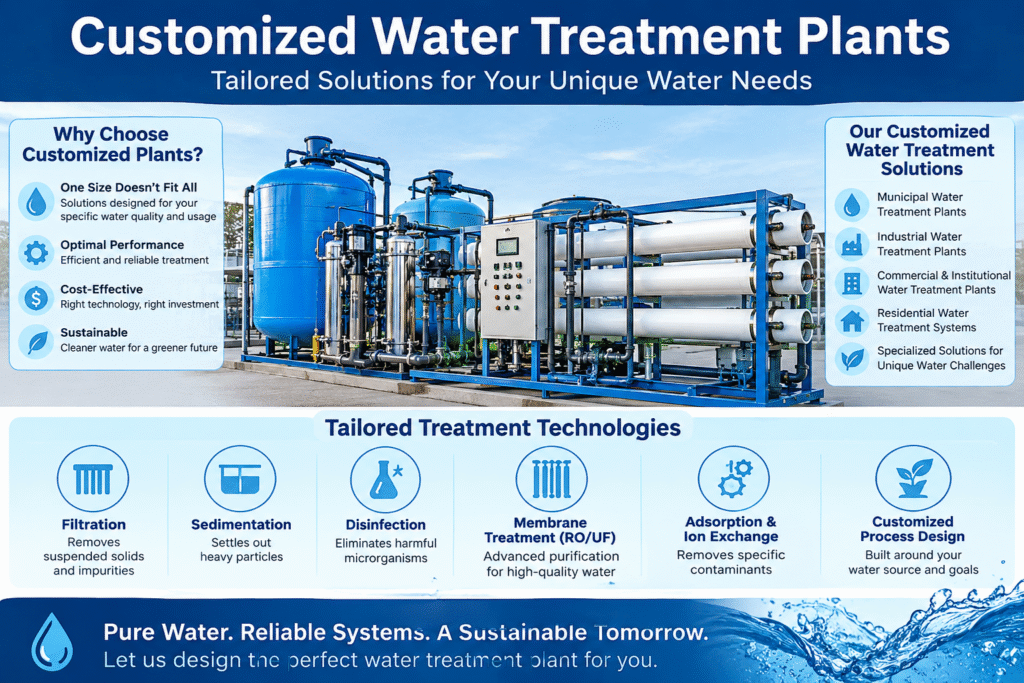
Why “One Size Fits All” Doesn’t Work for Industrial Water Treatment
It’s easy to assume a water treatment plant is a water treatment plant — that what works for one factory will work for another. That is rarely the case in practice. The requirements for industrial water treatment are dependent on a number of variables which vary from site to site:
1. Industry Category
A textile dyeing unit, a pharmaceutical formulation plant, a food and beverage facility and a steel or engineering unit all behave very differently with water. Some industries require ultra-pure water for their processes, while others are mainly concerned with treatment and safe disposal of wastewater generated during production.
2. Water Supply
The type and level of treatment required depends on whether the facility draws water from municipal supply, ground water (borewells), surface water or a combination of sources. Different pockets of ground water may have different mineral or contaminant profiles Municipality supply may be more or less consistent depending on area and season
3. Existing Contaminants
Suspended solids, hardness-causing minerals, dissolved salts, organic matter, oil and grease, heavy metals or chemical residues specific to the industry may be present in raw water and wastewater streams. The treatment technologies needed depend on the type and concentration of these contaminants.
4.Production Process
The quality standard of water before use and the nature of the effluent generated afterward depend on how water is used within the process, as a raw material input, a cooling medium, a cleaning agent, or a carrier for chemicals.
5. Water Volumes Consumed
A small manufacturing unit and a large processing plant will require very different flow rates and capacities. Proper sizing of a plant (not oversized or under-sized) is important for cost efficiency and reliable operation.
6. Discharge Requirements
The standard of treatment needed may differ depending on where the treated wastewater is discharged (municipal sewer, water body) or reused on site. Facilities located in and around Kolkata and West Bengal should determine the discharge requirements that are applicable to their specific location and industry category during the plant design process. These may differ according to the jurisdiction and the use case.
The lesson: these variables are interrelated, which is the reason a proper water and wastewater characteristics assessment should always precede finalizing a plant design — not after.
Important Phases of Treatment to Know
The specific combination and sequence of technologies utilized is entirely site-assessment dependent, but most industrial water treatment plants are constructed from some combination of the following stages.
Pre-treatment
Pretreatment is usually the first step and is used to protect downstream equipment. This could be the removal of larger solids, oil separation, pH adjustment, or chemical dosing to prepare the water for more sensitive treatment processes.
Filtering
Filtration removes turbidity and suspended solids. This can be simple sand and multimedia filtration, to finer micron-level cartridge or membrane filtration, depending on the application and based on the particle size and load in the water.
Relaxing
Over time, hard water, which has a high calcium and magnesium content, can cause scaling in boilers, cooling towers, and pipelines. Where hardness is a risk to equipment or process quality, softening systems, usually ion exchange, are employed.
Reverse osmosis (R.O.)
RO systems remove dissolved salts and impurities on a standard molecular scale, leaving high purity water. Industries with strict process water quality standards, such as pharmaceuticals, food and beverage, and some manufacturing processes, or those requiring boiler feed water to meet specific purity levels often require this.
Waste Water Treatment
Production effluent often needs treatment before discharge or reuse. Depending on the nature of the effluent, this may involve a combination of physical, chemical and biological treatment processes, such as biological treatment for wastewater with a heavy organic load, or physico-chemical treatment of effluents containing suspended solids and certain chemicals.
Why the Right Configuration Should Be Assessed, Not Assumed
It is easy to assume that a treatment plant configuration that has worked for one industry will automatically work for another, even in the same broad sector, but that is a mistake. For instance, effluent characteristics of two textile units may differ significantly depending on the dyes and chemicals used, the volumes of production and the existing infrastructure.
A more dependable approach is:
1.Water source and quality testing – what is actually in the raw water and wastewater streams.
2.Defining treatment goals — Is the goal potable-grade water, process-grade water, safe discharge, or water reuse (or some combination)?
3.Understanding production patterns, whether continuous or batch, peak demand periods, and seasonal variation in usage.
4.Site restrictions — space available, utilities on the site, and plans for future expansion.
5.Regulatory & discharge considerations – specific to location and industry category.
This is how Unilax deals with industrial clients – looking at the specific water characteristics and needs of the site and then designing a plant configuration around that, rather than proposing a standard package regardless of what the assessment shows.
Advantages of a Custom Water Treatment Plant
There are several practical advantages to designing a plant to the specific needs of the facility, not merely adapting a generic template:
Right-Sized Capacity
Designing the plant on actual and projected water use avoids the inefficiencies of an oversized system (higher capital cost and wasted space) or an undersized system (frequent strain and inadequate treatment during peak loads).
Space Saving
Within and around the industrial belts of Kolkata, industrial land and floor space can be a real constraint. Custom design enables the equipment layout to be designed around the available footprint, rather than jamming a standard layout into a space that wasn’t designed for it.
Smooth Operations
If a plant is designed for a certain process and water chemistry, then day-to-day operation is more predictable — less surprises from equipment specs that don’t line up.
More Practical Maintenance Scheduling
And custom-designed systems typically have maintenance schedules and spare-part planning based on the actual equipment installed and the actual water quality being treated, not on generic assumptions.
Future Expansion Room
Businesses expand and volumes of production vary. An inherently scalable plant – even if the first installation is small – can make subsequent capacity additions much easier and cheaper than retrofitting a fixed, non-scalable plant.
Better Alignment of Long Term Costs
While a tailored system may need more upfront assessment work, getting the treatment process as close as possible to real needs will help avoid unnecessary over-treatment, under-treatment and the operational costs associated with either.
Kolkata & West Bengal Industries’ Considerations
Industries in Kolkata and greater West Bengal region cover a wide range of domains ranging from textiles, food processing, pharmaceuticals, engineering, chemicals etc. with often different access to municipal water infrastructure, groundwater sources and different discharge points.
Rather than make assumptions about local water quality and regulations (which vary significantly with specific location, industry category and evolving compliance requirements), facilities should:
Before finalizing any treatment plant design, perform site-specific water testing.
Speak to treatment providers who can assess the local conditions of each individual case.
Keep current on relevant local and state regulatory requirements for their specific industry and discharge method.
Instead of making broad assumptions about any particular area, Unilax partners with industrial clients throughout the region to evaluate these site-specific factors firsthand.
Partnering with a Water Treatment Partner like Unilax
Having a water and wastewater treatment partner with experience can make the process much easier when industries are considering a new plant or upgrading an existing one. A good partner should be able to do the following:
Conduct a comprehensive evaluation of the water source, contaminants present, and process needs.
Suggest a treatment plan from that assessment — not a fixed template
Design for adequate capacity, space efficiency and future growth
Support with installation and commissioning, planning of ongoing maintenance
Help the system to meet relevant discharge and reuse objectives
Unilax has engineered and commissioned specialized water and wastewater treatment systems for a variety of industrial clients, with plant configurations based on the specific results of each site assessment rather than a one-size-fits-all approach.
Conclusion
“Industrial water treatment is not a one size fits all. The ideal plant configuration will vary depending on the industry, the water source and contaminant profile, and the production process, consumption rates and discharge requirements of each individual site. A good knowledge of the main treatment steps (pretreatment, filtration, softening, reverse osmosis, wastewater treatment and recycling) is a good starting point for facility owners and managers but always remember that the ultimate system design should follow a proper site assessment.
If you are an industry in Kolkata looking at a custom water treatment plant, working with a provider who will assess before they design – like Unilax – can help you get the right sized system which is efficient to run and has room to grow.
Frequently Asked Questions
Q1. Why not develop a standard design of a water treatment plant for the industries?
This is because water sources, contaminants, production processes and discharge requirements differ greatly between industries and even between facilities in the same industry. A standard design can mean over-treating, under-treating or badly fitting the available space and budget.
Q2. What is the first thing to do in designing a water treatment plant?
Full characterization of the site raw water and/or waste water and good understanding of the facility treatment goals (process water quality, discharge compliance, reuse objectives).
Q3. Does every industrial plant require Reverse Osmosis (RO)?
Not necessarily. RO is typically used where very pure water is needed, such as pharmaceutical or food and beverage applications. Depending on the goals of the facility, they may require additional filtration, softening or other aspects of treatment.
Q4. Can treated wastewater be reused at a facility?
In many cases the treated wastewater can be reused, for example, for cooling or washing, depending on the quality of the treated water obtained and its intended use. This should be decided on a case by case basis.
Q5. What is a plant’s capacity determined by?
Capacity is typically based on existing water use, expected peak demand, and reasonable estimates of future growth so the plant is not too small for day to day operations and not too large for the actual load.
Q6. Is there any specific regulation for industrial water discharge in West Bengal?
Depending on the industry category, location, and the receiving water body or sewer system, the discharge requirements may vary. Facilities should not set requirements on the basis of general assumptions, but should verify what applies to their situation, preferably with the help of their treatment provider or compliance consultant.
Q7. How Unilax can help for a custom Water Treatment Plant in Kolkata?
Unilax works with industrial clients to determine their water properties and desired outcomes, then designs a plant configuration that fits including pretreatment, filtration, softening, RO, wastewater treatment and recycling stages as appropriate. It also helps you with capacity planning, space-efficient layouts and future growth.